ENTER · TAP TO BEGIN
The Midnight Compendium
Japanese
Urban Legends
Cursed Places & Real Killers

Anti Yūrei Yōkai Club

Twenty-eight stories in three chapters

Copyright © 2026 Anti Yūrei Yōkai Club. All rights reserved.

No part of this book may be reproduced, distributed, or transmitted in any form without the prior written permission of the publisher.

Chapters I and II are works of folklore and retelling. Chapter III discusses real crimes and real people, presented as non-fiction drawn from public record. Nothing in it is intended to glorify any act or any perpetrator, and the names of the dead are treated with care.

Read This First
A Word of Warning

Not everything in these pages belongs to fiction.

The first two chapters deal in the older fears: ghosts, curses, haunted objects, and the stories whispered to keep the dark from coming too close.

The third chapter is different.

That chapter steps out of folklore and into the real world. It contains murder. Suicide. Children who never came home. It names real places where real people suffered, disappeared, or died.

These stories were not included for shock. They were included because some darkness should not be cleaned away, softened, or forgotten.

Read carefully. Read slowly. And if something in these pages comes too close, close the book. Step away. Breathe.

The dark is patient.

It will still be here when you return.

About the Pictures
Image Disclaimer

The images in this book are not evidence.

Most of the pictures were created with artificial intelligence and are included only to support the atmosphere, tone, and emotional weight of the stories. They should not be understood as photographs, documentary records, or accurate reconstructions of real events.

Some images are inspired by real locations. Some may also use visual references connected to real criminal cases, including the faces of convicted or suspected murderers, with the eyes obscured. These images are not included to glorify, celebrate, or give fame to those people.

They are included as a warning.

Evil does not always arrive with a monster's face. Sometimes it looks ordinary. Sometimes it lives behind a familiar expression, a normal body, a human name.

The purpose of these images is not to shock, brag, or sensationalize tragedy. It is to help the reader understand that real darkness has existed in real places, and that the people capable of terrible acts were not legends, ghosts, or demons.

They were human.

Any Japanese writing that appears inside the images, such as signs, seals, papers, talismans, or background text, should be treated as visual decoration only. Because the images were AI-generated, such writing may be inaccurate, meaningless, or incorrect. The only words intended to be read as part of this book are the printed words set in type.

The writing is the record.

The pictures are only shadows.
Before You Begin
Introduction
Before You Begin

Japan does not bury its ghosts.

It names them.

It gives them roads, tunnels, bridges, forests, apartments, schoolyards, shrines, and abandoned rooms. It lets them settle into places until the place itself begins to feel alive with something old, angry, or unfinished.

This book is about those places, those stories, and the things people still whisper about when the lights are low.

Some of these stories were born hundreds of years ago, in a world of curses, spirits, yūrei, yōkai, hungry demons, and objects that should never have been touched. Others are modern: rumors passed between students, warnings shared online, stories that spread because someone knew someone who knew someone who saw something they were not supposed to see.

And some are not legends at all.

Some are true.

That is where this book becomes harder to read.

Because the deeper you go, the more the line between folklore and reality begins to rot away. A haunted tunnel may begin as a rumor, but behind the rumor there may be an accident, a disappearance, a murder, or a name people stopped saying out loud. A ghost story may sound impossible, until you find the real death underneath it.

Each story includes a section called The Truth Behind the Fear. That is where we open the door a little wider. We look at what is known, what is claimed, what was exaggerated, and what may have been invented to make the truth easier to survive.

Sometimes the truth kills the legend.

More often, it feeds it.

Because ghosts are not always created by imagination. Sometimes they are created by grief. By guilt. By violence. By the need to explain why something terrible happened in a place that still looks ordinary in daylight.

That is the real horror of this book.

Not that monsters exist.

But that sometimes, the monster was only the story people made afterward.

The real thing was worse.

So read the folklore with curiosity. Read the cursed places with respect. And when you reach the true crimes, read them carefully. They are not here to entertain you. They are here because real people were lost, real evil happened, and some stories should not be allowed to disappear quietly.

Open the book wherever you like.

The old stories will find you either way.

But if a page feels too close, close it.

Some doors are easier to open than to shut.

The Anti Yūrei Yōkai Club
牛の首
牛の首
Ushi no Kubi · Cow Head

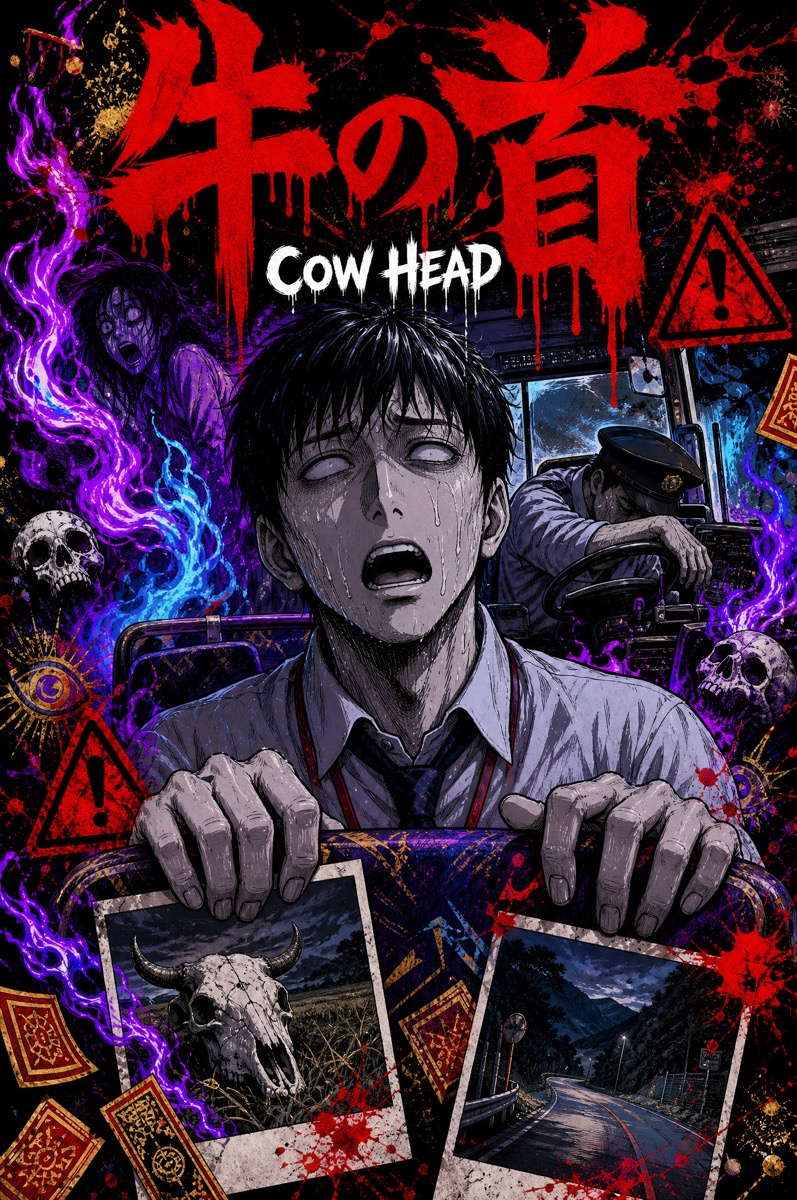
There is a story called Cow Head, and almost no one alive can tell you how it goes. That is the whole point of it. The few people who ever heard the story all the way to the end did not survive to repeat it, and so the story keeps itself secret.

What people pass around instead is not the story. It is what the story does to the person who dares to tell it.

There is one version everyone seems to know. A schoolteacher was on a long bus trip with his class. The children were bored and restless, and they kept begging him for something frightening, so at last he smiled and gave in. "All right," he said. "I know one. It is called Cow Head."

He managed only the first few sentences. Then his voice changed. It went flat and strange, as though he was no longer choosing the words, as though the words were simply pouring out of him on their own. His face turned pale and wet with sweat, and his hands gripped the seat in front of him so hard that his knuckles turned white. He wanted to stop. Everyone could see that he wanted to stop. He could not.

At the front of the bus, the driver slowly slumped forward over the wheel, and the bus rolled off the road and came to a halt by itself. And still the teacher kept talking, the terrible story spilling out of him into the silent, frozen bus.

When the passengers woke, several hours had passed, and no one could say where the time had gone. The teacher was alive, but only just, slumped in his seat, foaming at the mouth, his lips still moving without making a sound. He never told the rest of that story to anyone, for as long as he lived. Some say he never spoke properly again at all.

Every version of Cow Head ends the same way. Someone begins it. No one is ever allowed to finish it. They say it was written down once, long ago, and that every copy was burned, the ashes buried, and the ground above them sealed, just to be sure. That is why you will never read it, and you should be glad. Because the danger was never the cow, and it was never the head. The danger is the next word, the one already forming, quietly, somewhere behind your teeth.

The Truth Behind the Fear
Cow Head is a story about a story. The whole legend is simply the claim that the tale is too terrible to be told. It appears in old Japanese records from the Edo period, and the science-fiction writer Komatsu Sakyō made it famous in modern times by writing a story about the legend while carefully never saying what the legend actually contains. That is the trick, and it is a clever, cruel one. The box is empty, and you are the one who fills it, alone, in the dark, with the worst thing your own mind can imagine. And the mind never runs out of worse.
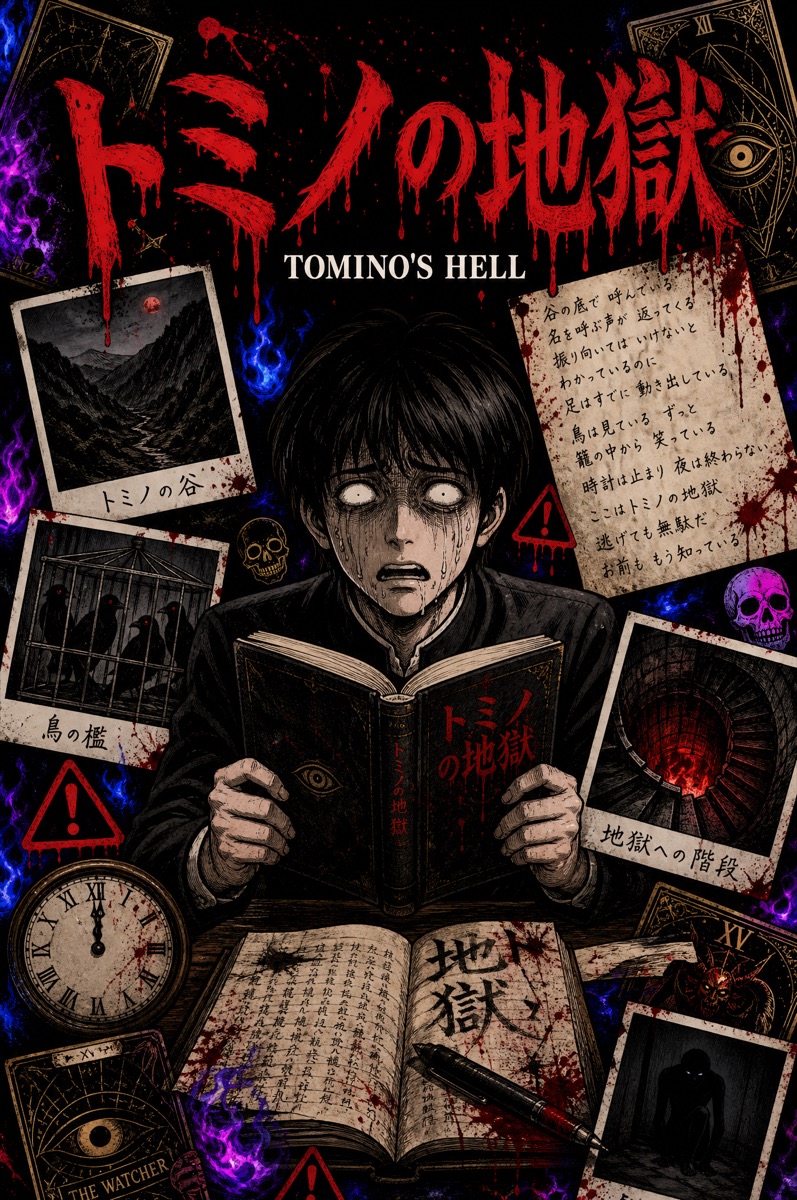
トミノの地獄
トミノの地獄
Tomino no Jigoku · Tomino's Hell
Read this with your eyes only. Do not move your lips. Whatever you do, do not say a single word of it out loud.

On paper, people say, the poem is harmless. It is only ink and quiet paper. The danger begins the moment you give it your voice and read it out loud.

The poem tells the story of a little boy named Tomino, who is sent down into hell. He goes looking for his older sister, somewhere in the dark below, climbing down and down, past cages full of birds that sing and never stop, down past seven mountains and seven valleys, far further than any living person should ever go. No one is supposed to follow him there. That is the whole point. When you read the poem out loud, line by line, you are following him.

The people who have done it describe the same things afterward, when they are willing to describe anything at all. First the cold, a draft moving through a room with no open window. Then the feeling that the room has grown longer behind them. And near the end, the worst part: their own voice slows down and steadies and stops sounding like their own, as though someone has quietly sat down behind their shoulder and begun to read along.

The clearest warning we have is a video. A man decided to record himself reading the whole poem aloud, to prove there was nothing to it. For the first minute he is calm, almost bored. Then, slowly, he begins to change. He shifts in his chair. He looks up from the page, once, then again, and then he keeps glancing toward the corners of the room, as if he can hear something the microphone cannot. His reading grows quieter. His eyes stop following the words on the page.

In the last thirty seconds, he goes completely still. He is staring at something low in the corner, off to his left, that the camera never shows. He stares for a long, long time, and his face is the face of a man looking at something that should not be in the room with him. He does not scream. He does not finish the poem. He simply reaches out, very carefully, and closes the book, and switches the camera off. He never read the rest of it, not that night and not ever. Whatever he saw, he decided that never knowing how the poem ends was the safer thing to live with.

That is the part that should frighten you most. Not a man who died reading it, but a grown man who would rather stop forever than say the next line.

The poem is real, and old, and still out there in the world. We have chosen not to print it inside this book. Some doors are not ours to open for you. But if you truly mean to risk it, it is not hard to find: look for "Tomino's Hell" by the poet Saijō Yaso, from his 1919 collection Sakin. When you do, read it the way you have read this story, with your eyes only, and not a single sound. Whatever happens after that is yours.

The Truth Behind the Fear
The poem is real. A man named Saijō Yaso wrote it, and it was published in 1919 in a collection called Sakin, which means Gold Dust. He was not a sorcerer or an occultist. He wrote poems for children, and read simply, this one is about grief: a child going down into the land of the dead to find a sister he cannot bear to lose. No curse was attached to it for almost a hundred years. Then, in the 2000s, it spread across Japanese message boards, and people began daring each other to read it aloud, and the dare is what made it dangerous. Believing the curse costs you nothing. The only way to prove it is harmless is to read it out loud and find out, and that is a bet you can only lose once.
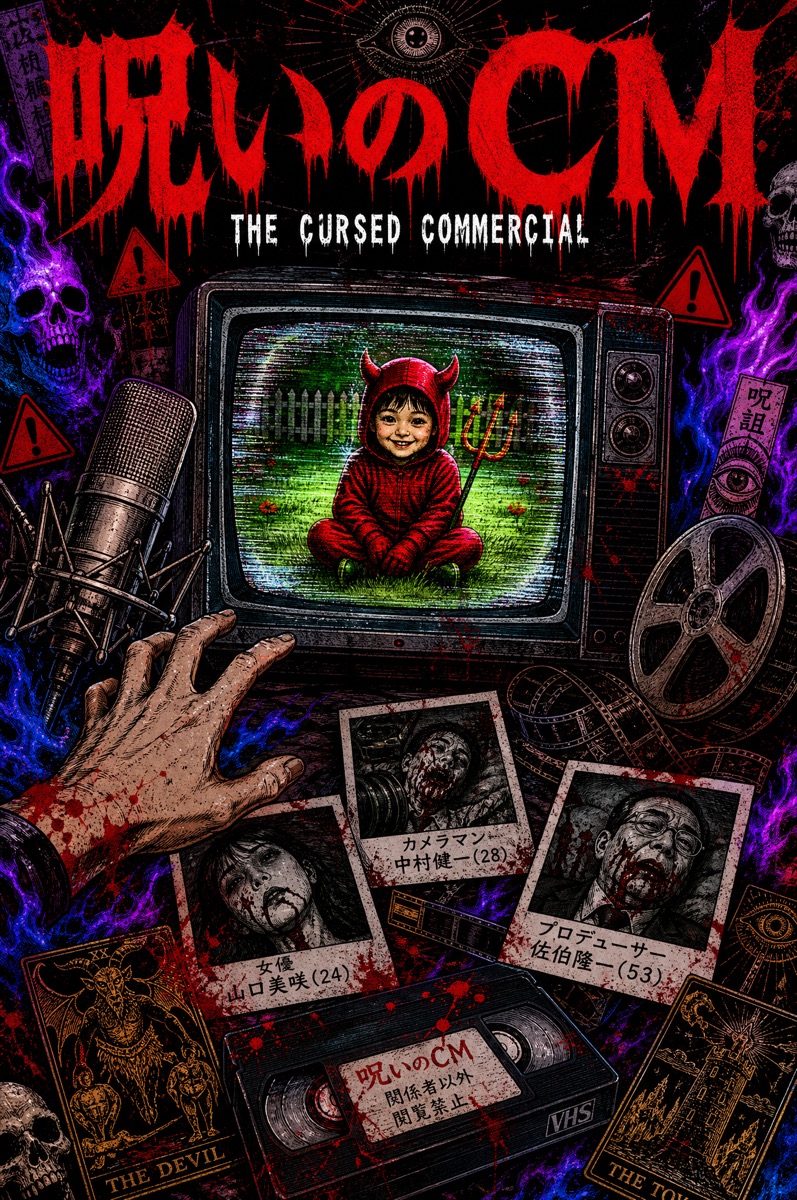
呪いのCM
呪いのCM
Noroi no CM · The Cursed Commercial

It was only fifteen seconds long. The commercial aired a handful of times, always late at night, long after midnight, and then it was gone. On the screen, a small child in a red ogre costume sat on a lawn so green it looked wet, while somewhere off camera a woman sang something soft and slow in a language that was not Japanese. That was the whole of it. Nobody who saw it could say why it left them so uneasy. They only knew that it did, the way a smell can seem wrong for a second before your mind catches up and understands what it is.

The frightening part is not the commercial. It is the three people who made it, and what became of each one.

The child went first. A few months after the commercial stopped airing, the little one who had worn the red costume was hit by a car on a quiet street near home, and did not survive.

The singer went next. She was a foreign woman, flown in to record the song, and not long after the session she simply stopped being anywhere. She never made her flight home. She left nothing behind and was never seen again, the kind of missing-person case that stays open for decades and quietly leads nowhere.

The last was the man who had approved the commercial for broadcast. He hanged himself, alone, in a locked room. The detail the few surviving crew cannot let go of is that the television was on when he was found, and the fifteen-second commercial was playing on the screen, on a channel that had not aired it in more than a year.

Years later, someone went looking for the original recording. Not for the curse. They wanted to find the singer, to put the rumor to rest, to prove she was alive somewhere and the whole thing was nonsense. So they sat down and played the tape again, slowly, to study the song and trace the language she had been singing. And the language was Japanese. Plain, clear, unmistakable Japanese, words that had not been there before. And it was not her voice. It was a different woman entirely, one none of them knew, singing words none of them had ever written.

Except there had only ever been one singer in that booth. One woman, one session, one voice on the master tape. No overdub, no second recording, no one else in the building that night, and they checked all of it. The song had simply changed, on a tape that had sat untouched in a drawer for years, into a different language in a different voice. The people who heard what it was singing now, plain and clear in Japanese, will not repeat the words. They will only say that it was no longer a song, and that whatever it had become, it knew they were listening.

The Truth Behind the Fear
This story grew out of something real. In the mid-1980s a Japanese commercial for tissues showed a small child dressed as a red ogre, sitting on grass so bright it looked unreal, with a gentle foreign song playing underneath. Something about it unsettled the people who saw it, and a rumor took hold that everyone who worked on it had come to a bad end soon after. Here is the honest part, and it is worse than any clean answer would be. None of those deaths was ever confirmed. But none of them was ever disproved, either. Nobody has produced a death certificate, and nobody has produced the people themselves, alive and well and wondering what all the fuss was about. The child, the singer, the man who signed off on it: no one has ever been able to say where any of them is now. The station says the master tape was lost long ago. Stations always say that. A curse is the one kind of claim you can never check, and a story that no one can close is a story that never has to end.
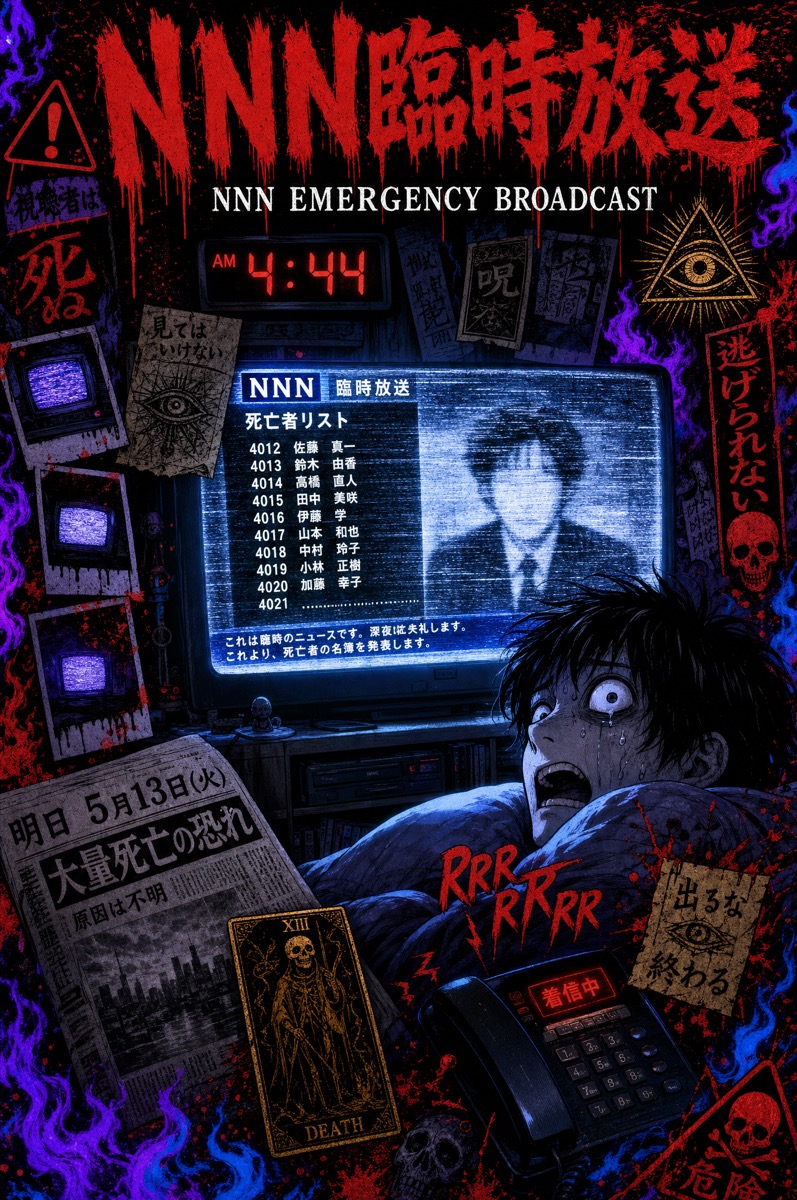
NNN臨時放送
NNN臨時放送
NNN Rinji Hōsō · NNN

You wake at exactly 4:44 in the morning, and you do not know why. The room is dark, and the television is on, and you did not leave it on.

There is no channel and no program, nothing that belongs on the air at this hour. The screen is split down the middle. On the right is a list of names, scrolling slowly upward, and a voice is reading them out, one at a time, calm and patient. Ta-na-ka. Hi-ro-shi. Each name given its full weight, each one followed by a number that, after the third or fourth, you understand is an age. On the left is a single photograph of a face, and every time the voice finishes a name the picture changes to the next person, so that the face on the left always belongs to whoever the voice has just spoken.

They are not the photographs people keep. Nobody is posed, and nobody is smiling. Each person is shown in the exact state in which they died, and the screen lingers on every one of them without flinching, and after a moment you realize that you are not flinching either.

Some part of you knows at once that this is wrong, that no station broadcasts this, that the only right thing to do is get up and walk out of the room. But the voice keeps reading in that even, gentle tone, and the list keeps climbing with no end to it that you can see, and the longer you sit there the more you have to know how far it runs, and whose names are on it, and how close it has come to the names you know. Somewhere in the dark your phone begins to ring, and you do not answer it. You only keep watching. That is the whole trap, and it is built out of nothing but your own wanting to see.

In the morning, some of those names are in the paper, in the small notices at the back that nobody ever reads. Died in their sleep. Died suddenly. The same names, in the same order the voice read them, hours before anyone alive could have known.

So the next night, when you wake at 4:44 and the television is on again, you already understand what you are looking at. And this time you understand the rest of it: the list does not stop at the people who are already gone. It keeps going, past tonight, into tomorrow and the day after, name by name by name, and if you stay and follow it long enough, the voice will reach your own.

Here is the only thing the story tells you, and it tells you once, so listen. The moment you understand what is on that screen, do not keep watching. Get up. Whatever it costs you, however heavy you feel, put your feet on the floor, cross the room, and pull the television out of the wall. Because if you stay, and you let the list climb, you will hear your own name read out slowly in that calm, patient voice, and the photograph on the left will change to you. It will not be a picture of you as you are now, sitting up in the dark. It will be the picture of how you die. And once the screen has shown you that, there is nothing left to undo. The ones who stayed to look were found the next morning sitting up in front of a television that was switched off, eyes open, already wearing the face from their own photograph. The only version of this story that anyone walks away from is the one where they got up in time.

The Truth Behind the Fear
NNN is real. Nippon News Network is one of Japan's main commercial news consortiums, the network behind Nippon Television, a channel that has been on real screens in real homes for decades. The legend borrows that name and wraps it around a broadcast that does not exist, which is exactly what makes it work. A transmission from a channel nobody has heard of is easy to dismiss. One that carries the name of a network you grew up watching is harder to shake. The rest of the fear is the same as it has always been: the time 4:44, because the number four in Japanese is pronounced shi, the very same sound as the word for death, stacked three times over. And a television that knows your name.
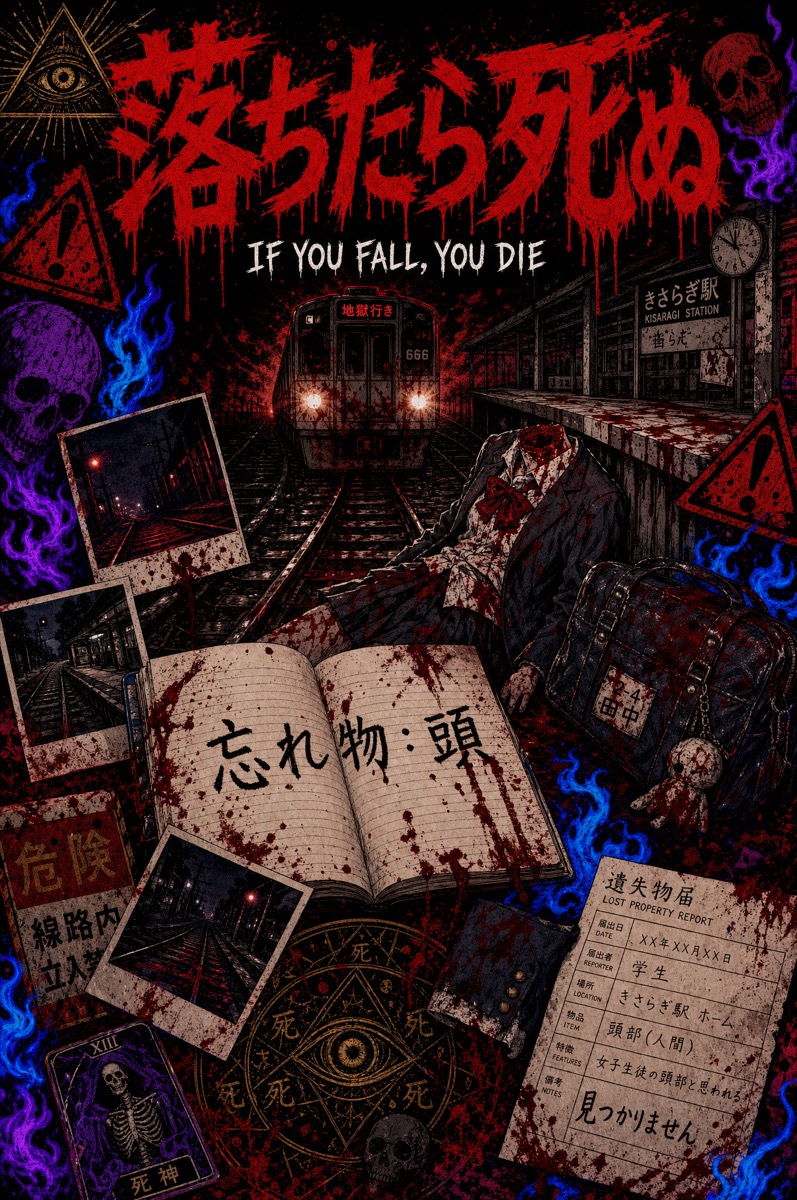
落ちたら死ぬ
落ちたら、死ぬ
Ochitara, Shinu · If You Fall, You Die

It is very late, and you are almost alone on the platform, waiting for the last train of the night. The lights at the far end of the station have already been switched off, and the announcements have stopped. There is only you, and, down near the dark end, one other person. A small boy in a school uniform, standing right at the edge, his toes over the yellow line, staring down at the tracks as though he has dropped something into the dark between the rails.

You should keep to yourself and wait for your train. But he is so small, and standing so close to the edge, and there is no station staff left to pull him back if he leans too far. So you walk down toward him, and you ask him, as gently as you can, whether he is all right.

He does not turn around. He says he is looking for something. He dropped it onto the tracks, he says, and he has been trying to reach it for a very long time. His notebook. His school notebook. He needs to get it back.

You follow his gaze down, and there it is, lying open in the gravel between the rails: a child's notebook, its pages somehow clean and dry in all that grime. There is a small drawing on the open page, and a few lines of writing beneath it. You lean out a little over the edge to read what it says.

It is a lost-and-found form, the kind every schoolchild in Japan fills in. A line for the item that was lost, written out carefully in round, childish handwriting: my head. A line for the date, which is today's date. And a line for the name of the person who lost it.

The name is yours.

Not a similar name. Not a common name that could belong to anyone. Your name, your family name and your given name, in handwriting you recognize, because it is your own. The way you wrote it in elementary school, before your hand grew up.

You are still trying to understand this when you notice the boy has turned to face you. And that is when you finally see him. He has no head. He never did. There is only the dark collar of his uniform and the cold night air above it.

Before you can step back, two small cold hands press against you and shove, and you go off the edge. As you fall, you see the white light swelling in the mouth of the tunnel, and you hear the last train arriving, exactly on time. The form was filled out before you ever reached the station. All the boy needed was for you to come down the platform and confirm it.

The Truth Behind the Fear
Japan's train stations are full of ghost stories, and the reason is not hard to find: train deaths happen often enough to leave real grief at real platforms. The story is built around something completely ordinary, the lost-property form every Japanese station uses, where you write your name, the date, and what you lost. The horror is not just the impossible item on the last line. It is the name. The paperwork for what happens next was completed long before you arrived, in your own childhood handwriting, as if some part of you signed it years ago and has been walking toward this platform ever since.
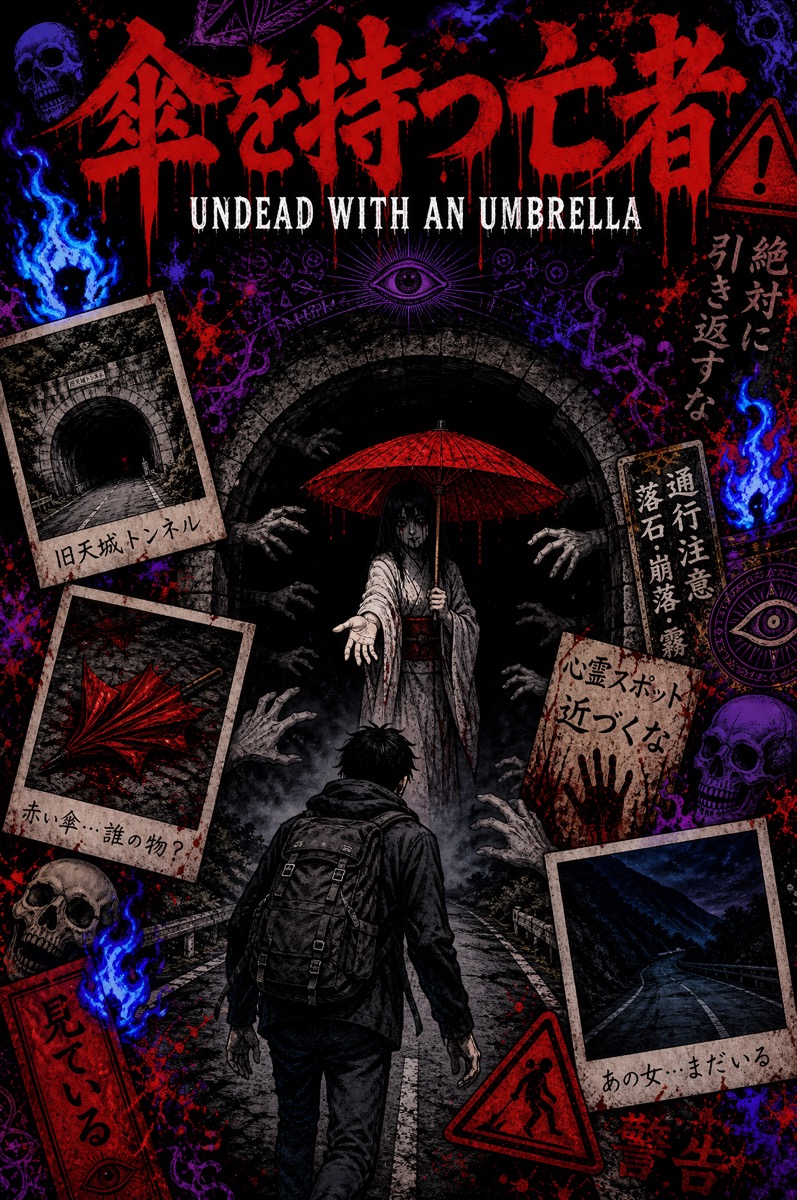
赤い傘
赤い傘
Akai Kasa · The Red Umbrella

You are walking home late on a rainy night, the last stretch after the last train, down a quiet street with no one else on it. You have no umbrella. The rain has soaked through everything you are wearing, so you keep your head down and just try to get home.

That is when you see her, a little way ahead, standing still under a streetlight. A woman in a white kimono, holding a red umbrella open over her shoulder. She is perfectly dry. Not damp, not dripping. Dry, as though the rain has simply agreed not to touch her. And she is already turned toward you, watching you come, as if she has been standing there waiting for exactly this. For you, on exactly this night.

As you reach her, she smiles, and she offers, very softly, to share her umbrella. She is gentle and kind, and you are cold and soaked and tired, and the rain is so loud. That is the whole trick of it. The people who say yes, who step in under the red umbrella to walk beside her, are found later somewhere they had no reason to be, far off any path they would ever take. They are dry. They are smiling. They have been dead for some time, and yet, when they are found, their bodies are still warm.

So you do the sensible thing. You shake your head, you say no thank you, and you keep walking, head down, into the rain.

That is when you hear it behind you. A small, sharp tapping. The metal tip of an umbrella, touching the wet pavement. Tap. Tap. Tap. Keeping perfect pace with your steps. It never catches up to you, and it never falls behind. It follows you the whole way home, around every corner, right up to your door.

You get inside. You lock the door, and you check it twice, and the tapping stops at the threshold like a guest with good manners. You tell yourself it was only the rain. For a week, you almost believe it.

Then you come home one clear evening, and there is a red umbrella standing in your entryway. Closed. Upright. Resting against the wall among your own shoes, as if it has always lived there. It is wet. It is dripping a small dark ring onto the floor, though the sky has been empty and blue for days, and your door was locked, and you checked it twice, and it was.

You did not take the umbrella. You said no. But the rain that falls around her does not seem to care what you said, because that night, lying in bed, you hear it begin: not tapping this time, but rain, soft and steady, falling somewhere inside the house. And beneath it, unhurried, something climbing the stairs.

The Truth Behind the Fear
She is a version of the ame-onna, the rain woman, a spirit that Japanese folklore says arrives with storms and leaves with them. People have placed her on quiet night streets and lonely mountain roads alike, anywhere a person might be caught out in the rain with nowhere to shelter. The fear she plays on is small and very human: how hard it is to refuse a kindness from a stranger, especially when you are cold and tired and someone is finally being gentle with you. Red is the color of the charms meant to turn evil away, and it is also the color of blood. On a ghost, an umbrella that color is not an offer of shelter. It is a warning, if you can read it in time.
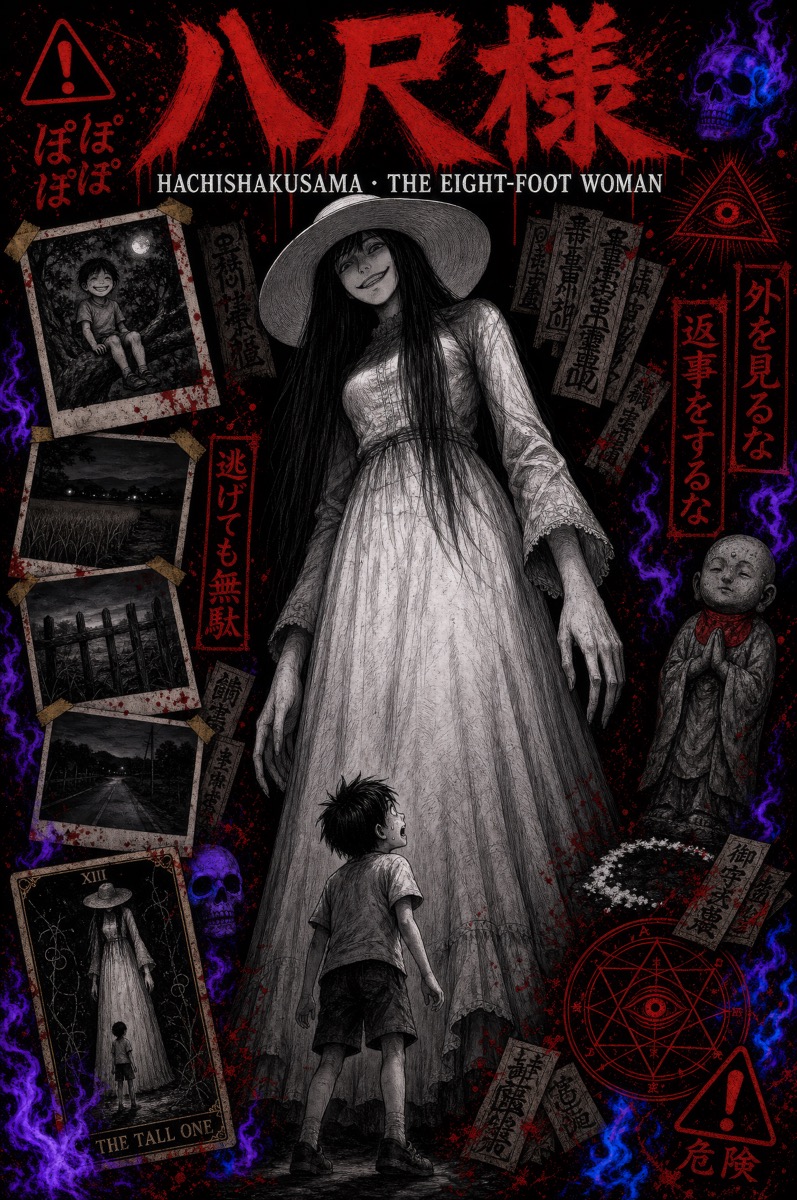
八尺様 · The Eight-Foot Woman
八尺様
Hachishakusama · The Eight-Foot Woman

The first thing is the sound. A boy is spending the summer with his grandparents, out where the houses sit far apart and the rice runs up to the hills, and he is in the garden in the long light of early evening when it comes from the other side of the fence. A low voice, flat and empty, with no warmth of any person in it. Po. Po. Po. Over and over, patient, almost like laughter with everything human boiled out of it.

He looks up, because of course he does, and over the top of the fence, which stands taller than a grown man, there is a head. A woman, looking down at him. She wears white, an old-fashioned white dress and a wide pale hat, and she is smiling, and she is far too tall. The fence reaches past most people's eyes. It does not reach her chest. She must be eight feet from the ground to the crown of that hat, and she stands there looking down at a small boy in a garden, smiling, going po, po, po, and the boy's body understands before his mind does that he has to be inside, now, and he runs.

When he tells his grandfather what he saw, the old man's face does something the boy has never seen an adult's face do. It empties out. The grandfather makes two phone calls in a voice the boy is not allowed to hear, and then the rules begin. They put the boy in a back room and cover the windows. They paste strips of paper inked with prayers over the door and across the walls, pour a ring of coarse salt along the threshold, and set a small dish of rice and a stone statue in the corner. He is told the rules once, plainly, the way you tell a child something you cannot afford for them to get wrong. Do not go outside until the sun is up and we come for you. Do not open the door. And whatever you hear out there, whatever voice it uses, do not answer it.

The night is very long. For a while there is only his own heartbeat. Then, late, the sound finds the room. Po. Po. Po, just outside the wall, close enough to touch if the wall were not there. It circles. He hears it pass the window, the door, the far wall, and come round again, unhurried, all night, as if it has all the time that has ever existed. And then it stops being patient, and it starts to use voices. His grandfather's voice, telling him it is morning, come out now, it's safe. His mother's voice, from a house hundreds of miles away, asking him to open the door, just for a second, just to see her face. The voices are almost perfect. Almost. There is a flatness under each one, the same dead note as the po, po, po, and it is the only thing that saves him, because everything in his body is begging him to answer, to open the door, to let his mother in. He bites down on his own arm until it bleeds and he stays silent.

At the first gray of dawn the prayers go quiet outside, and his grandfather, the real one, peels the paper off the door and carries him out through the back of the house with a cloth over his head so he cannot see the fields, and drives him fast out of the district and does not stop for a long time. The boy lives. That is the version with a happy ending, and it is the one people tell, because the others are unbearable.

In the others the family is too late, or the child answers just once, or there is no grandfather left who knows the old ways. There the legend goes quiet in the way that lets you fill the silence yourself, except for the one thing it always says. The child is found within a few days. Not far away. Sitting, usually, somewhere they could not have climbed to alone, a high branch, a sealed room, the middle of a field with no footprints leading in. Whole, and unmarked, and emptied of every drop of blood, drawn out slowly across one long night by something that was in no hurry at all. And smiling. Wearing her smile now, the one from over the fence, fixed on a small face that will never make any other expression again.

The Truth Behind the Fear
Hachishakusama, the eight-foot woman, eight shaku being an old measure of around two and a half meters, first appeared as an online horror story in 2008, posted by someone who claimed it had happened to them as a child. It sticks because so much of it is built from real folk practice. The countryside it describes is real countryside, the kind with emptying villages and grandparents who still keep the old protections. The inked paper strips are ofuda, genuine talismans. Salt has been used to purify and to ward for centuries. And the detail that the woman cannot leave the area, penned inside an invisible boundary by a ring of stone Jizo at the village edges, comes straight from a real tradition: the roadside Jizo and dōsojin that mark the border of a community and stand guard against what tries to come in from outside. Under the modern monster is one of the country's oldest fears, kamikakushi, the belief that a child can simply be taken, hidden away on the far side of the world's thin places, and returned, if at all, as a small empty body for the living to find. The story is invented. The grandparents pasting paper over the windows are doing something their ancestors would have recognized.
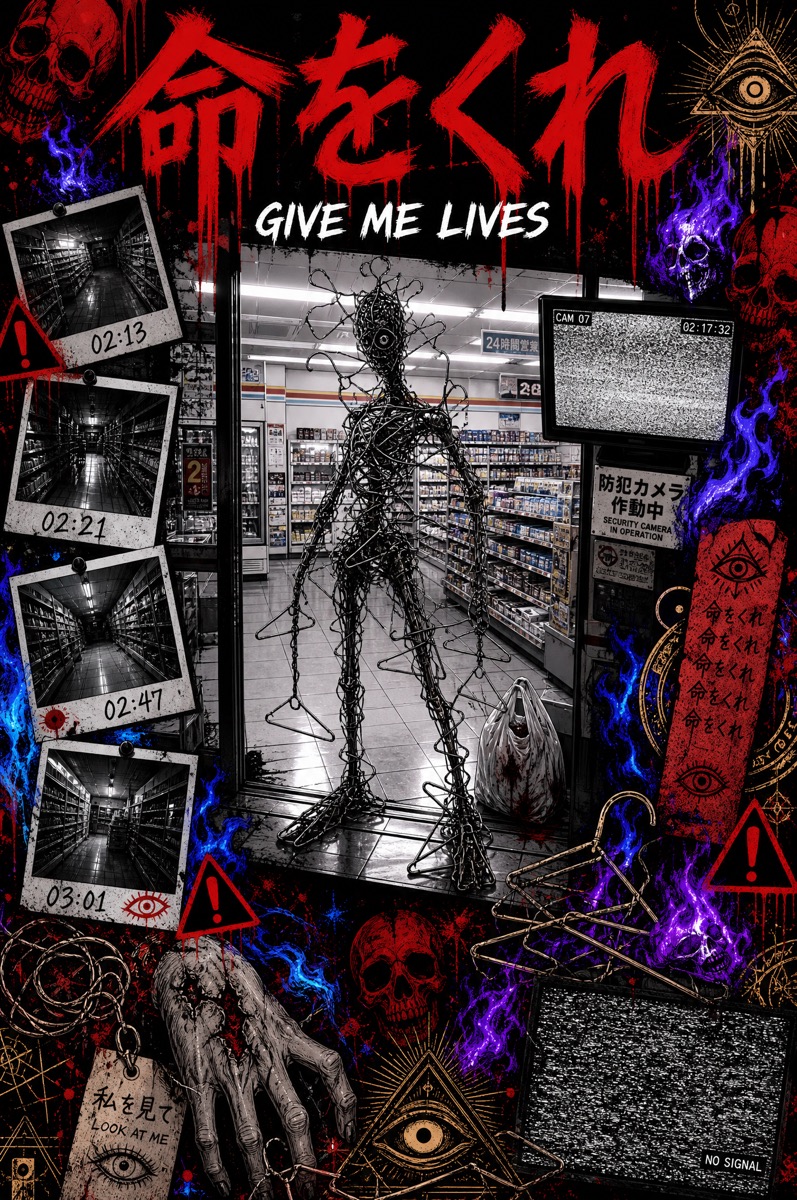
命をくれ
命をくれ
Inochi o Kure · Give Me Lives

A convenience store is the safest place in Japan at three o'clock in the morning. It is lit as brightly as a hospital room. It never closes. There is one clerk behind the counter and a camera watching from every corner. That is exactly why this story is so frightening, because it happens in the one place where nothing bad is ever supposed to happen.

The clerks who have seen it all tell it the same way, in the same flat voice. A figure comes in from the empty street. It is too thin to be a real person, although it is shaped like one. Its joints bend the wrong way, and always a moment too late, as though something is reading instructions on how a human body is supposed to move and getting them very nearly right. It crosses the floor to the counter the way a puppet would cross a stage. It does not buy anything. It leans in close, close enough to breathe on you, and says three words, flat and quiet and final. Inochi o kure. Give me lives. And then it waits, very politely, for an answer.

The clerks who run away are always fine. The clerks who freeze, who do the polite and well-trained thing and stay at their post, are simply not there when the morning shift arrives. The register is open. The shift is half finished. There is no sign of a struggle, and no sign of the clerk, and no sign that anyone had been standing there at all an hour before.

And here is the detail the clerks hate to talk about, the one they will only give you if you keep them talking long past the point where they should stop. The cameras never capture it. There are hours of clean, boring footage of the clerk standing alone, smiling slightly, speaking very politely to no one at all, nodding at the empty air in front of the counter. Then there is a single frame in which the clerk is gone. Not walking away. Not turning. Simply gone, the way a name is crossed off a list. And days later, it comes back to the same store, at the same hour, carrying in its thin arms whatever it took the last time, holding it up so that you can see it, so that you understand what kind of exchange this is. And then, as patient as ever, it asks again.

The Truth Behind the Fear
The all-night convenience store is the loneliest holy place in modern Japan. It is open, bright, and empty in the smallest hours of the night, with one tired person standing at the center of it, trusting a ring of cameras to keep them company and keep them safe. That trust is exactly what the story attacks. The real fear is not the thin figure at the counter. It is the small, cold idea underneath it: that the screens we hand our safety to, the unblinking electronic eyes we count on to watch over us, can quietly and completely fail to see us at all.
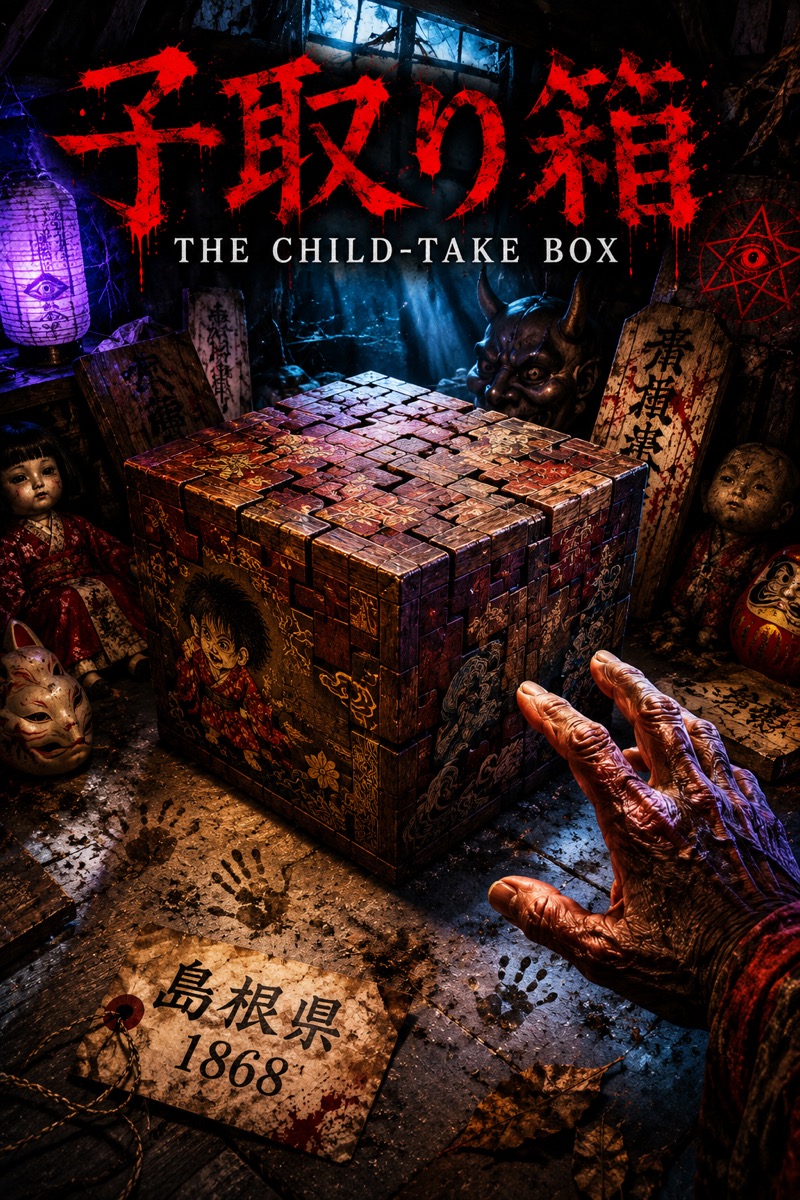
子取り箱 · The Child-Take Box
子取り箱
Kotoribako · The Child-Take Box

In 2005, a man in Shimane Prefecture posted a story on a Japanese message board. He was not trying to frighten anyone. He wrote like a man filing a report, and that is what makes it hard to put down.

He and a few friends were helping clear out an old family property in the countryside. In a storage shed, under decades of dust, one of them found a wooden box about the size of a lunchbox. It was beautiful. Dark, dense wood. Interlocking pieces fitted together so tightly you could not see how it opened, or whether it opened at all. The friend turned it over in his hands, admiring the joinery, and said he wanted to take it home for his daughter.

An older man from the neighborhood had come by to help. When he saw what the friend was holding, he stopped moving. Then he told him, very quietly, to put it on the ground and step away from it. Not to drop it. To put it down gently, and to step away.

They laughed at first. He did not.

What he told them, once they were outside, was not a ghost story. It was a family instruction, the kind passed from father to son with the understanding that it should never be written down. In the 1860s, he said, the area held a small settlement of people the surrounding villages treated as less than human. They could not trade fairly. They could not marry out. Their children died of hunger at a rate everyone knew about and no one discussed.

One year, a stranger came through the settlement, fleeing from something he would not name. In exchange for shelter, he taught them a craft. How to build a box that carried a grudge.

The box had to be made a certain way, and it had to be filled a certain way. What went inside came from children. Blood from a stillborn child. A fingertip from a living one, taken while the child was still alive, because the box did not work otherwise. The village had no shortage of dead and dying children. For the first time, even their losses could be made useful.

The finished box was called a kotoribako, a child-take box. You did not keep it. You gave it. Slipped it into the home of a family from one of the villages that had spent generations grinding yours down. Nothing happened at first. That was important. A curse that strikes too quickly teaches people what to fear. Then the women in the house began to sicken. Then the children. Doctors found nothing, because there was nothing to find. It took months. The men were left alive to watch, because that was the point.

The boxes were graded by what had gone into them. One child. Two. Four. The old man said the one in the shed had been made with eight, a class so dangerous that even the people who built it became afraid of their own work. It was never delivered. It was sealed away instead, and one family in each generation was given the job of keeping it isolated until its strength wore out. That was believed to take about one hundred and forty years.

The men did the arithmetic standing in the yard. The years had not passed yet.

The posts describe what happened next in the flat tone of someone still inside the problem. Phone calls to families who were supposed to be watching other boxes. The discovery that some had moved house, died, or simply stopped believing. The realization that not every box could be located anymore. And one detail the narrator mentions almost in passing, the way you mention a thing you cannot yet afford to think about: the friend's wife had been in the car with the box on the drive home. By that evening, she was describing a pain low in her abdomen that would not stop.

The thread ends without an ending. The missing boxes were never accounted for. Somewhere, if you believe the story, a handful of small wooden puzzles are sitting in Japanese homes right now. In drawers. On shelves. In storage rooms no one has opened for years. Waiting out a countdown that only one family per box was ever supposed to remember.

The Truth Behind the Fear
The kotoribako story appeared on the Japanese message board 2channel in June 2005, told by an anonymous poster as a true account. It has never been verified. No box has ever been produced. No physical evidence has ever confirmed the story. As evidence, it is worthless. As a map of old fears, it is harder to dismiss. The world underneath the legend was real. Japan's outcast communities existed for centuries, forced into "unclean" work, shut out of ordinary village life, restricted in marriage, and trapped in poverty that surrounding communities helped create, then blamed them for. Infanticide in poor rural Japan was real too, common enough to have its own soft word: mabiki, "thinning." The same word farmers used for pulling excess seedlings so the rest could live. That is the engine under the floorboards of this story. A community with nothing. Children already dying. Grief with nowhere to go except back toward the people who made it ordinary. The box is fiction. The rage it runs on is not. The scary part was never the box.
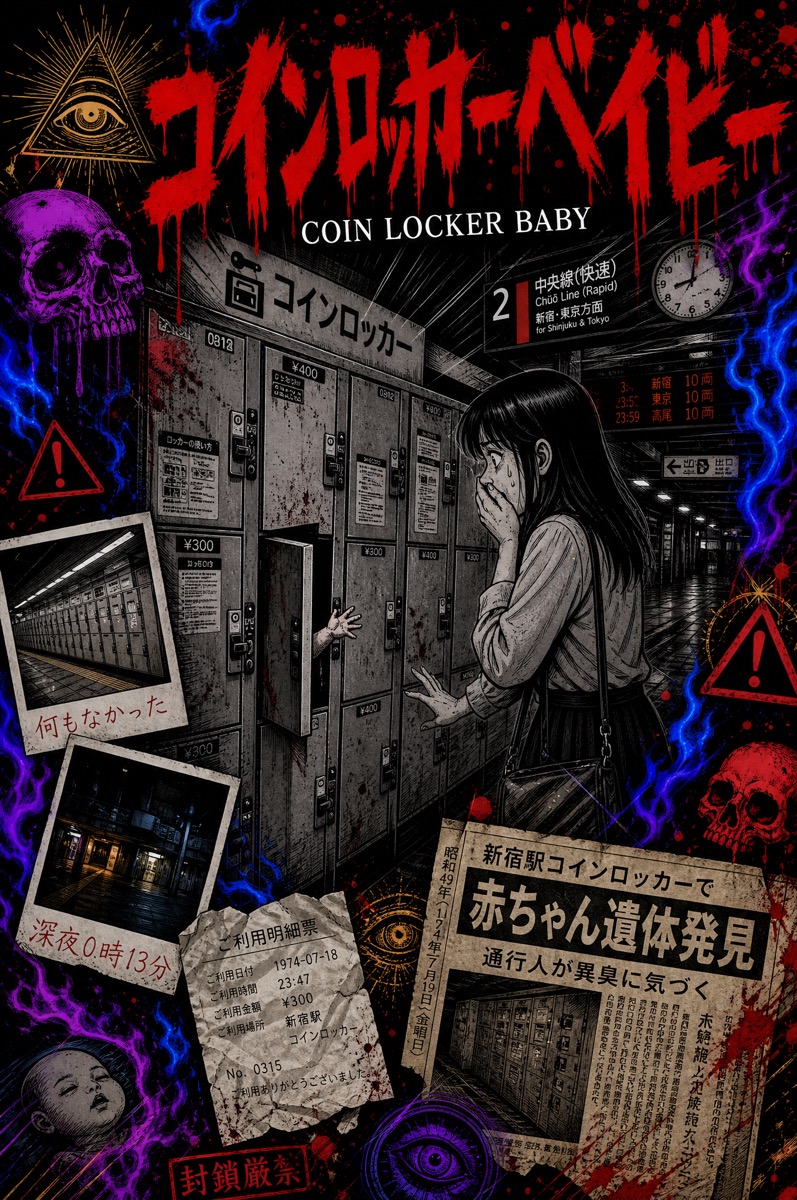
コインロッカー・ベイビー
コインロッカー・ベイビー
Coin Locker Baby
Content warning. This one is about a baby, and it is genuinely disturbing. If that is not something you want in your head tonight, skip ahead to the next chapter.

She was very young. The boyfriend who had gotten her pregnant had been seeing someone else the entire time, and she had no idea at all what a person was supposed to do with any of it. So when the baby came, her panic reached for the only plan it could find. She wrapped the baby up. She carried the small, warm bundle to the train station. She put coins into a locker, placed the baby inside, and closed the door.

She told herself a story so that her legs would keep walking. Someone would hear it crying. Someone would open that little door, lift the baby out, and carry it home, and it would be safe, and loved, and better off than it would have been with her. She lived nearby. She would somehow know when the happy ending arrived.

For weeks she walked past that bank of lockers and watched, out of the corner of her eye, for police tape, or a gathered crowd, or any sign at all that something had been found. There was never anything. The lockers stayed shut, and silver, and silent. So she let herself believe that no news was good news, that nothing happening meant the kind thing had happened. She was young. People believed worse things than that in those years, and walked away with clean hands.

She grew older. There was a different man, a gentle one this time. There was a small wedding. And years later she was pregnant again, this time happily, heavy and slow and full of joy, walking across that same station hall, when she heard a child crying somewhere ahead of her.

It was a little boy, standing alone on the platform. The strange thing was not the boy. The strange thing was the crowd. It flowed around the place where he stood as though that space were empty. No one slowed down. No one looked at him. No one else seemed to hear what she was hearing. Of course she went to him; her whole body was already leaning toward the sound before her mind had agreed to move. She crouched down to his level. She reached out her hand. She began to say something soft and warm, the kind of thing you say to a frightened child.

The boy went quiet all at once. He looked up at her, calm, not blinking, with an expression that no small child should be able to make. And he said: it was you.

They found her three days later. The same station. The same row of lockers. Something was leaking out from underneath one small steel door, slow and dark, spreading across the floor. There was a small handprint pressed against the outside of the door, pressing outward, from the inside. It took two officers and a crowbar to force it open. What they found folded inside that locker, packed into a space far too small for any grown woman's body to fit, was her.

The Truth Behind the Fear
The ghost story is invented. What lies underneath it is not. In Japan in the early 1970s, there really was a wave of newborn babies abandoned to die in train-station coin lockers. There were so many that "coin locker babies" became a common phrase, and by 1980 it was the title of a famous novel. You do not need a ghost for this one, and that is what makes it the worst story in the chapter. Real babies really were left to die in steel boxes, in stations full of warm, hurrying, ordinary people walking past. All the legend adds is one mercy and one cruelty, which turn out to be the same thing. It lets one of them come back. And it lets it ask why.
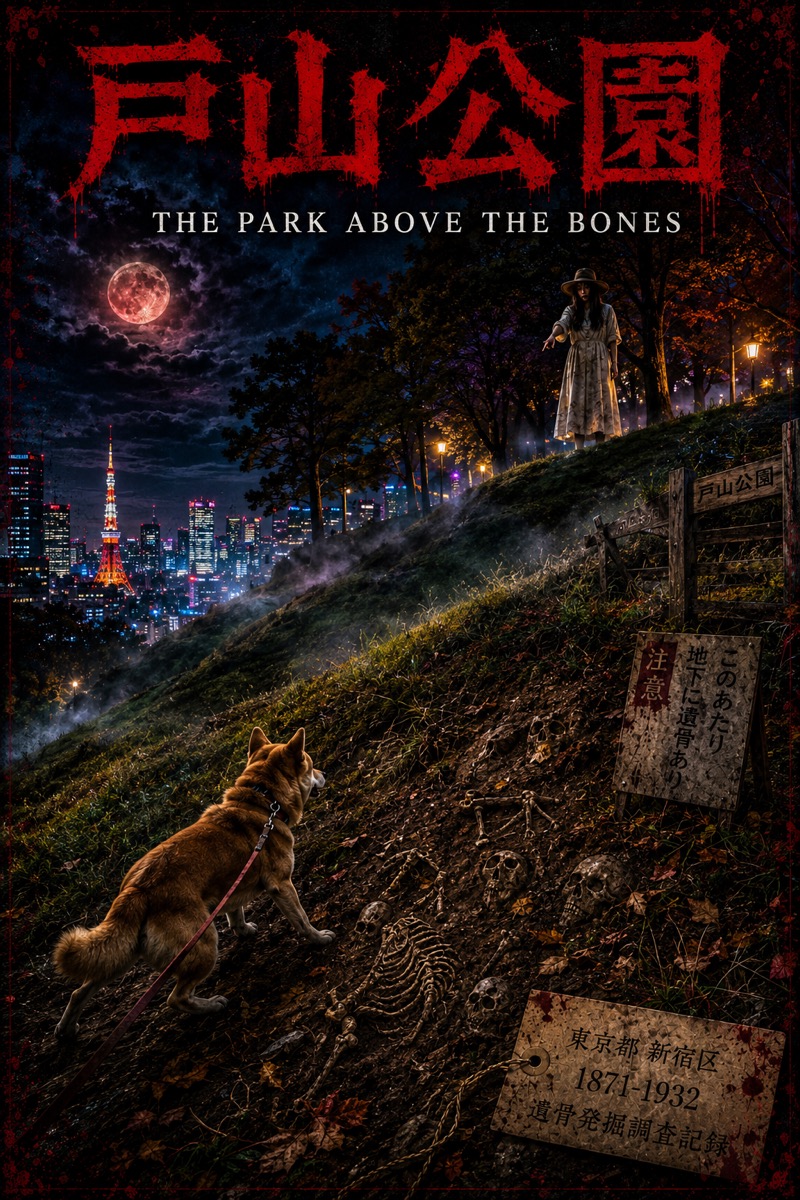
戸山公園

Toyama Park sits in Shinjuku, a short walk from Takadanobaba Station. By day, it looks ordinary: paths, trees, families, runners, children climbing Hakoneyama, the grassy artificial hill at its center. The hill is only forty-four meters high, but in the Yamanote area, that is enough to make it the highest point around. People climb it for the view. Children roll down it. Dogs, according to the story, refuse to go up at all. That is where the unease begins. Dogs stop at the bottom of the slope and shake. Some dig at the same patch of grass, frantic and whining, then back away as if they have uncovered something that should have stayed under the ground. At night, people say the hill changes. The air breaks into cold pockets, hard and sudden, the size of a person standing still. You walk through one and feel, for a second, as if you have passed through someone who was already there. Then there is the woman in old white clothing, seen near the edge of the trees. She does not look at you. She looks down. One arm hangs at her side, and the other points toward the grass. If you follow her finger and then look back, she has come closer without seeming to move. Still silent. Still pointing. Now her finger is aimed between your feet. People say that is the worst part: the moment you understand she is not warning you. She is showing you. She wants you to know what you are standing on.

The Truth Behind the Fear
On 22 July 1989, construction work near the future National Institute of Infectious Diseases uncovered human remains on land once occupied by the Imperial Japanese Army Medical School. Reports described bones from many individuals, including skulls and limb bones, some with marks that suggested cutting or drilling. The site mattered. The former Army Medical School had connections to Japan's wartime epidemic- prevention research network, including the world around Unit 731, the unit associated with human experimentation and biological-weapons work in occupied China. A former school worker, Toyo Ishii, later claimed that specimens were buried there in the chaos after Japan's surrender. The official conclusions never satisfied everyone. A later Health Ministry investigation suggested the remains were likely connected to medical training or wartime study, many probably of non-Japanese Asian origin, but it could not firmly identify the dead or directly connect the bones to Unit 731. That uncertainty is why the place still feels unfinished. It is not a clean cover-up story, and it is not a clean answer either. The hill is green. Families still picnic there. The question under the grass remains.
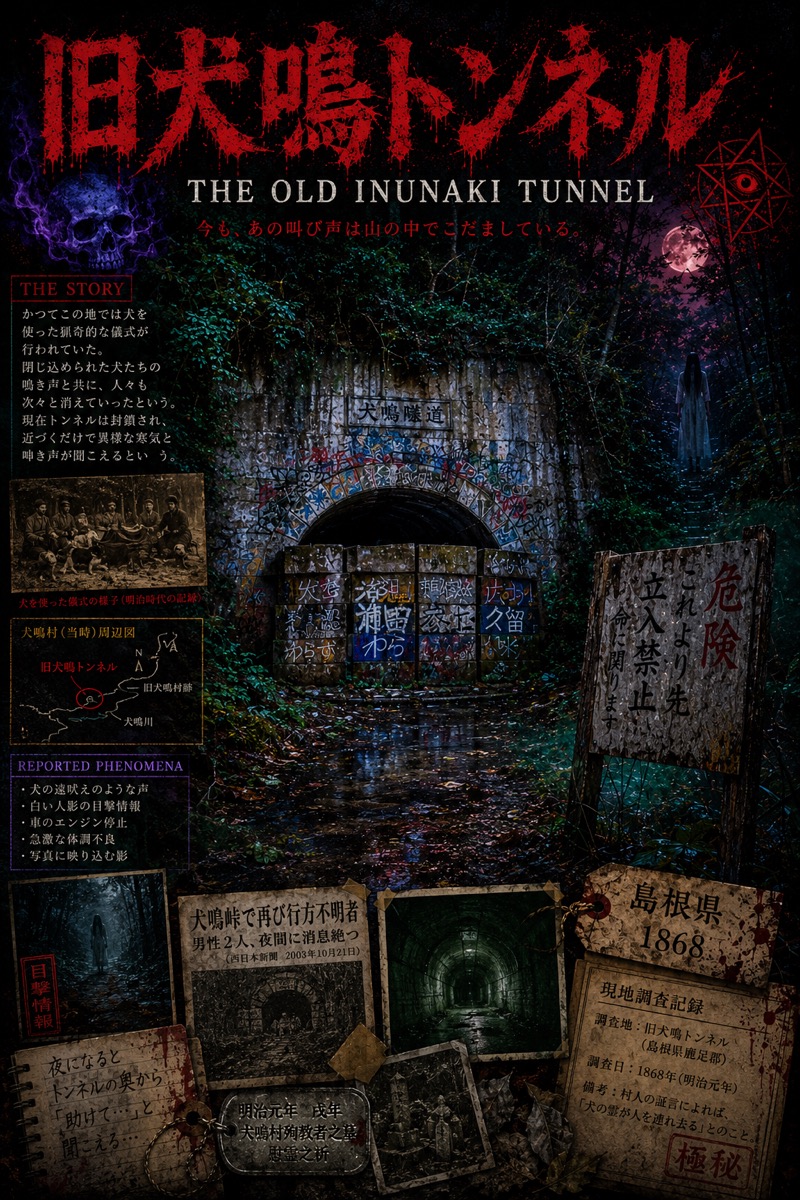
旧犬鳴トンネル

In the hills of Fukuoka Prefecture, there are two Inunaki tunnels. The new one carries traffic today. The old one, further up the road, was abandoned and later sealed with concrete and stone. That part is real: an old road disappearing into trees, ending at a tunnel mouth deliberately walled shut. The legend says that beyond the sealed tunnel lies a village cut off from the rest of Japan. At its entrance, a hand-painted sign warns that the Constitution of Japan does not apply past this point. Inside, the story goes, live people who answer to no law and do not welcome outsiders, especially outsiders with cameras. Most people never see the village. What they bring back are smaller, more believable details. Phone signal dies the moment the trees close over the road. Headlights catch a figure standing ahead, and in the half-second before the driver brakes, it vanishes. On the way back, the car feels escorted, as if something is walking just behind the bumper, slow and patient, making sure the visitors leave its territory. People say you only realize how frightened you were when the signal returns and your phone suddenly begins buzzing with all the messages that could not reach you inside.

The Truth Behind the Fear
The old tunnel's reputation is tied to a real killing. In December 1988, near this area, a 20-year-old factory worker named Koichi Umeyama was abducted by teenagers, beaten, robbed, taken into the hills, and burned to death. The killers were caught and convicted. That documented crime, combined with the sealed tunnel and the isolation of the old road, gave the legend a place to grow. Later, the film Inunaki Village pushed the story into wider public awareness and drew more thrill-seekers to the area. The village beyond the tunnel has never been shown to be real. What happened to Koichi Umeyama was.
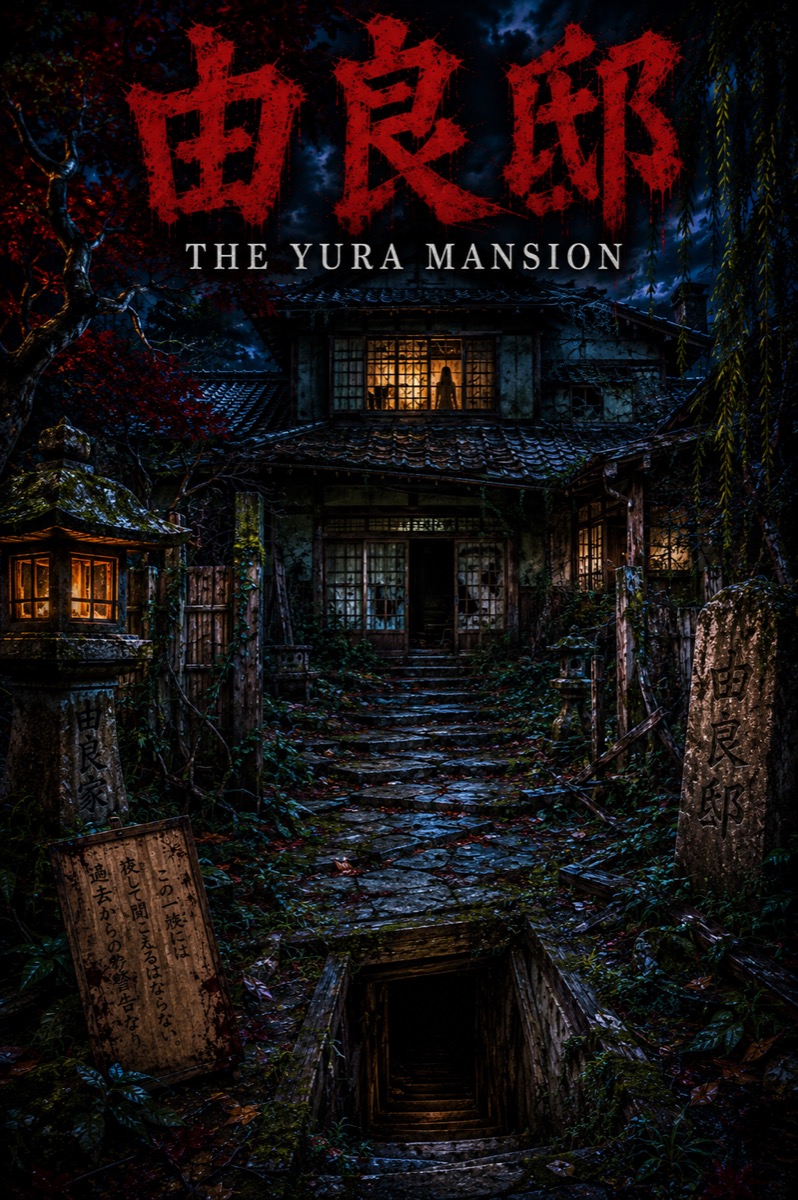
由良邸

On a mountainside in Wakayama Prefecture stands a Western-style mansion, empty for decades and slowly being taken back by the trees. It looks displaced: a piece of Europe left behind in the Japanese hills, stone darkened by weather, windows broken, the forest pushing its way inside. Visitors describe small wrongnesses rather than obvious horrors. No birds in the rooms. No insects. A silence too heavy for an abandoned house. Doors that were shut when they passed are open when they return. Sometimes, from deeper inside, a piano: a few uncertain notes, as if someone is trying to remember a tune in a building where no piano remains. The rumor people love is that the mansion inspired a famous horror game about a cursed mountain house and a family ritual. So they go looking for the room that should not be opened, the ropes, the sealed door, the proof. They photograph empty rooms and later find something pale standing in a doorway they are certain was empty. Maybe the house is connected to the story. Maybe the story simply found a house that looked ready to receive it.

The Truth Behind the Fear
The mansion is real. It was built in 1910 for Asajiro Yura, a chemist and industrialist from a family of textile dyers. He is associated with the refinement of industrial benzene, work that fed into explosives and wartime industry. The more dramatic stories around the house - lavish secret parties, powerful visitors, advance knowledge of Pearl Harbor - remain unproven. What is clearer is more human: Yura died in 1964, his family kept the property for decades, and by many accounts the house was eventually abandoned after family grief and decline. As for the game connection, it is best treated as fan legend rather than fact. The creator of the series has said the mansion was not based on a specific real building. Still, the attachment makes sense. A real industrialist's mansion, wartime money, family loss, and a mountain ruin are more than enough for a legend to move in.
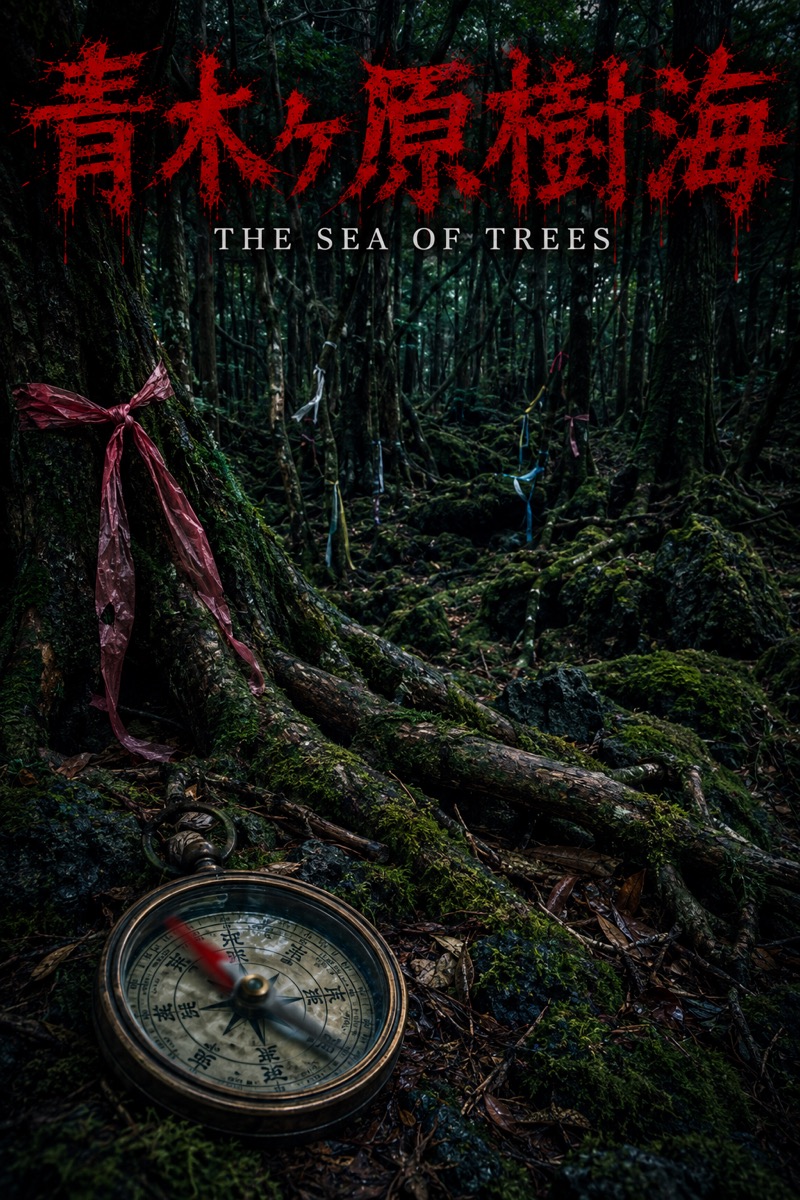
青木ヶ原樹海

Content warning. This place is real, and the real story involves suicide. If that is too heavy tonight, skip to the next entry. Aokigahara spreads across about thirty square kilometers at the northwest foot of Mount Fuji, rooted in a lava field left by a major eruption in 864. The trees grow over hardened lava rather than deep soil, so their roots crawl sideways across the surface, exposed and knuckled, as if the ground itself is gripping. The forest is dense and close. Lava caves breathe cold air from below. The canopy flattens the light until the hour feels uncertain. What hikers mention first is the silence. A few steps past the treeline, the sound of the road behind you cuts away as if someone has closed a door. What replaces it is not peace. It is absence. Hikers are told to stay on marked trails and to carry tape if they enter deeper areas, because it is genuinely easy to lose direction. They are told something else more quietly: if you find old tape tied by someone else, do not follow it. It may not lead out. It may lead to wherever that person was going when they stopped planning to return.

The Truth Behind the Fear
Aokigahara is not frightening because of ghosts. It is frightening because of human grief. The forest has long been known as one of the world's most frequent suicide sites, and the authorities have avoided publicizing numbers to reduce attention. Police and volunteers still conduct searches there. Some famous claims are exaggerated. Compasses do not simply spin everywhere in the forest; they can be affected if placed directly on magnetic volcanic rock, but the wider myth is overstated. The real danger is disorientation, isolation, and despair. At the trailheads, signs ask people who came there to end their lives to reconsider and reach out. That is the part worth respecting. Let the forest unsettle you for human reasons, not as a tourist thrill. If you are struggling, talk to someone immediately - in Japan, services such as TELL Lifeline and Yorisoi Hotline exist for that purpose.
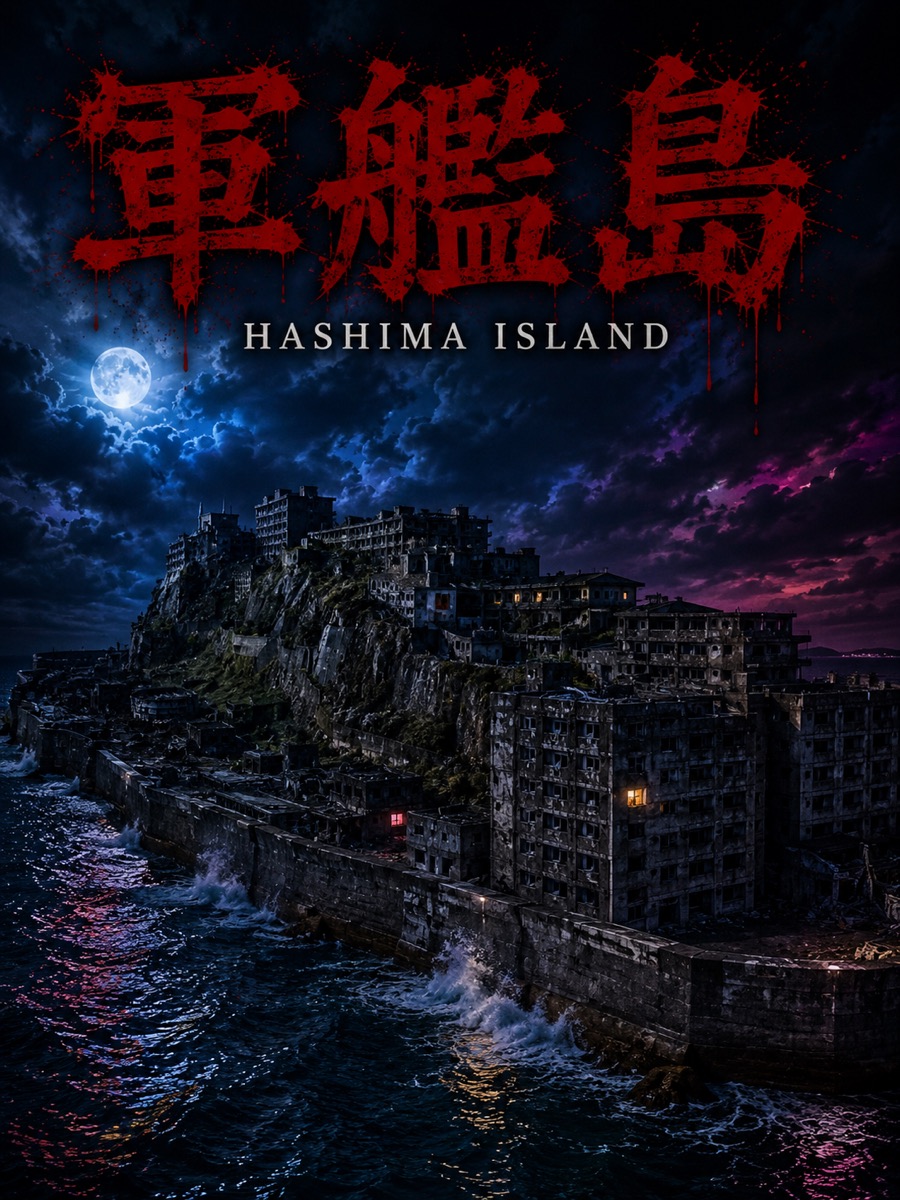
軍艦島

Hashima is a tiny island off Nagasaki, about 480 meters long and 160 meters wide, sealed by a high seawall. From the water, its concrete towers look like the silhouette of a warship, which is why everyone calls it Gunkanjima: Battleship Island. Mitsubishi bought the island in 1890 and mined coal from shafts that ran deep underground and far beneath the seabed. To house the workers, they built upward, creating one of Japan's earliest dense vertical communities: apartment blocks, schools, a hospital, shops, a shrine, a cinema, and narrow concrete corridors where thousands of people lived pressed together above the sea. Visitors who linger at the end of the tour describe sounds that seem to come from the empty buildings: footsteps above them on floors no one has safely crossed for decades, a child's voice drifting from the ruined school, curtains moving in glassless windows when the wind has stopped. The strongest feeling is not that the island is empty. It is that the island is still occupied, room after room, with only the bodies missing.

The Truth Behind the Fear
In 1959, Hashima held more than 5,000 people in an extremely small area, making it one of the most densely populated places ever recorded. But the island's history is not only industrial nostalgia. During the 1930s and 1940s, Korean and Chinese laborers were brought or forced to work in harsh conditions connected to Japan's wartime labor system, and some died there. That history remains disputed in public memory and is often treated too lightly in tourism materials. The coal economy collapsed, and Mitsubishi closed the mine in 1974. The last residents left that year, and the island sat abandoned for decades before tours began in 2009. It became part of a UNESCO World Heritage listing in 2015. Today it is both a sightseeing destination and a contested war-history site. It does not need ghosts. The concrete, the salt wind, and the unfinished arguments do enough.
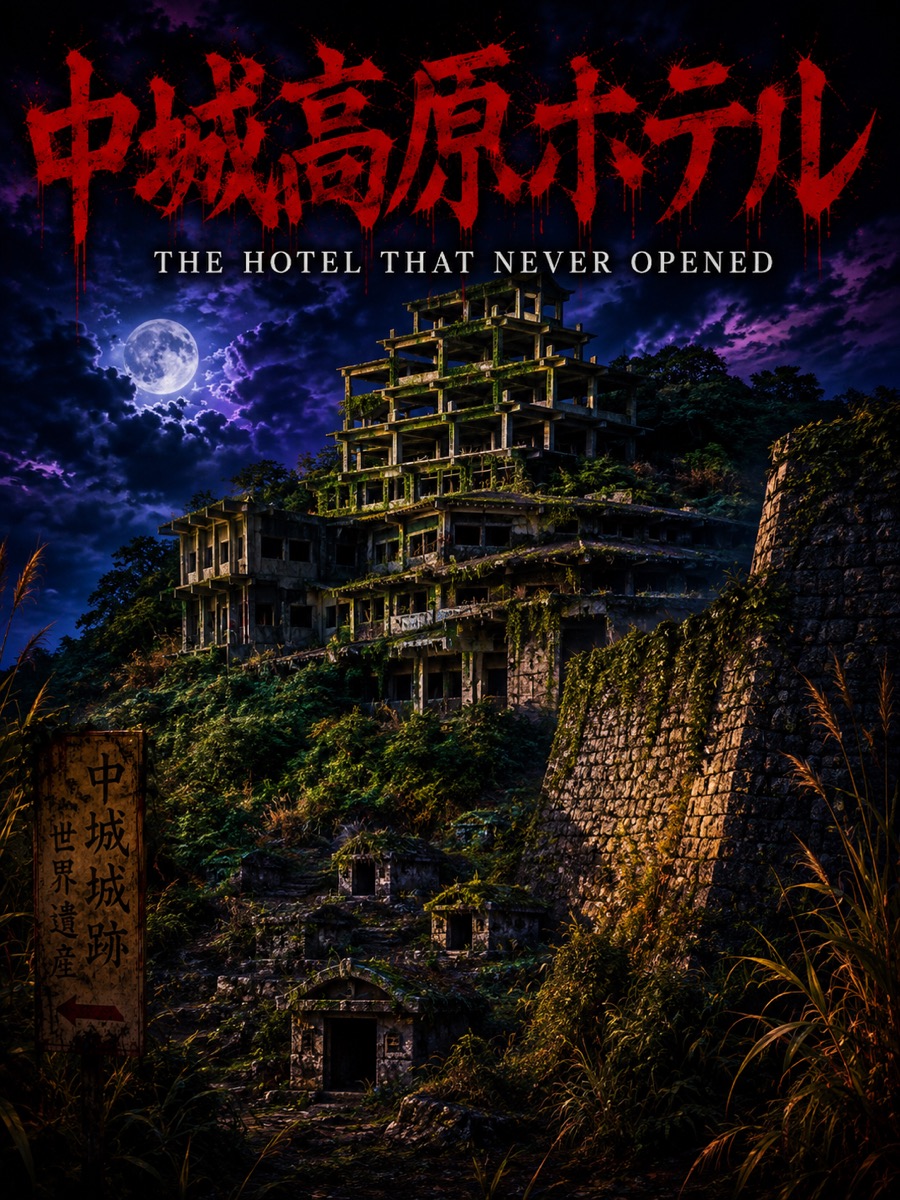
中城高原ホテル

On a hilltop in Kitanakagusuku, Okinawa, a few steps from the walls of Nakagusuku Castle, there once stood the concrete skeleton of a resort hotel that was never finished and never opened. For decades it sat above the village like a bad decision that refused to disappear.

The developer was warned before construction began. The hill held old tombs and sacred ground, monks and locals told him, and it should not be disturbed. He built anyway. Then the accidents started: workers falling, machinery failing, crews refusing to return.

To prove there was nothing to fear, the story says he spent one night alone inside the unfinished shell. At dawn, they found him alive, sitting calmly among the concrete pillars. After that, he was never the same. Whatever kept him company did not kill him. It only took the part of him that knew how to live in the ordinary world.

The Truth Behind the Fear
The ruin was real. The simplest explanation is probably also the strongest: construction likely stopped because money ran out, possibly complicated by access and heritage restrictions around nearby Nakagusuku Castle. The castle itself is genuine and historically important, with real battles, burials, and sacred associations in Ryukyuan history. That gave the abandoned hotel a powerful setting. It also gave storytellers an easy moral: build too close to old sacred ground, and the land will answer. The hotel gained a dangerous reputation while it stood. It was structurally unsafe, and the U.S. military reportedly placed it off-limits after a serviceman was badly injured exploring it. One detail matters for anyone looking for it now: the building is gone. It was demolished around 2020. The hill is quiet again, which may be the only ending the place ever wanted.
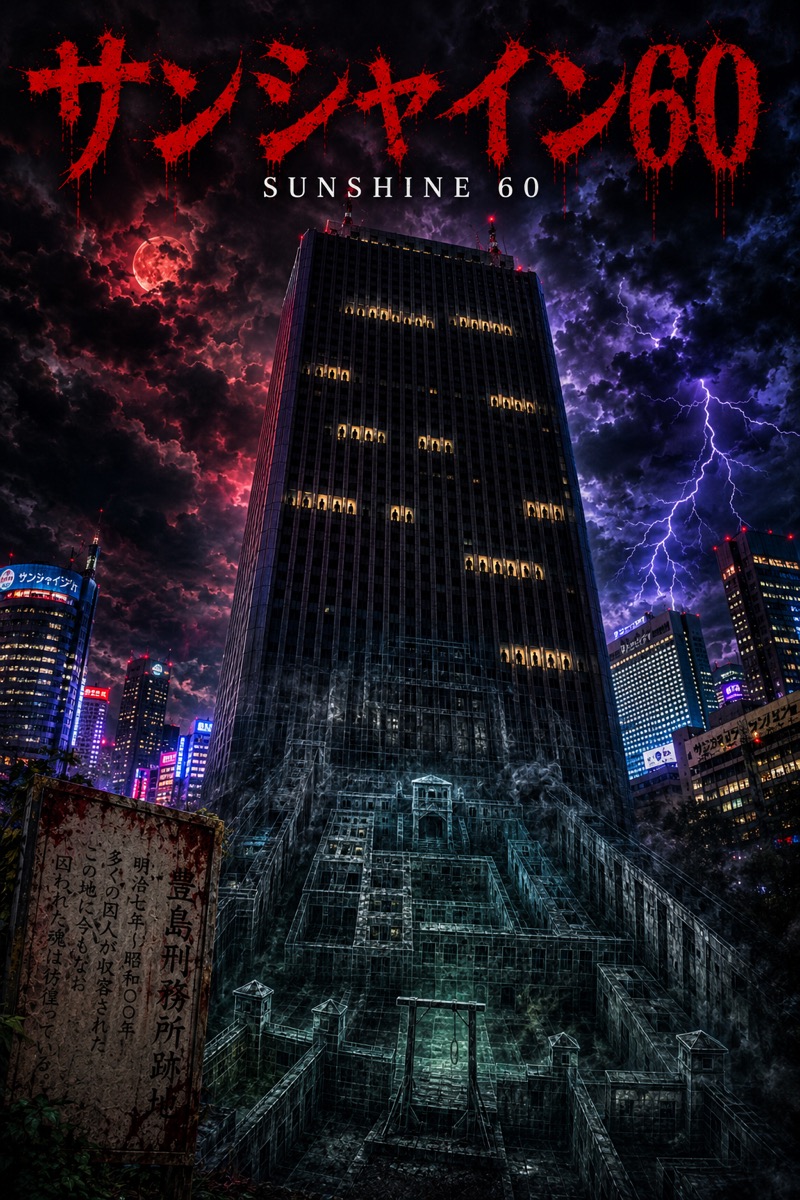
サンシャイン60

Sunshine 60 is a 240-meter tower in Ikebukuro, completed in 1978. For a time, it was the tallest building in Japan. Today it is offices, shops, restaurants, observation decks, and the ordinary machinery of a city stacked into the sky. Locals have long said the tower looks like a gravestone. That is not a joke about its shape. It is a statement about what the tower is standing on.

Before the tower, this ground was Sugamo Prison. For thirteen years after the war, it held the men Japan was trying not to think about, and on one night in December 1948, seven of them, including a former prime minister, were taken from their cells and hanged. The prison was torn down, the ground was renamed, and the tallest building in the country was raised on top of it, as if height could press something down.

What the night staff describe is not screaming or rattling chains. It is quieter and stranger than that. Cleaners on the high floors after midnight report figures standing in the dark offices, always in rows, always facing the same direction, the way men stand when they are being counted. An elevator that stops on its own at an empty floor, opens, and waits, holding its doors the way a guard holds a door. A stairwell where the cold pools so deep you can see your breath inside a heated building, and where more than one worker has reported the same specific thing: the feeling of descending past someone on the landing without ever seeing them, and the certainty, all the way down, of being watched from above by someone standing perfectly still.

No one reports seeing them walk. They are always already there, still and patient, as if they were placed and told to wait. The day staff work in a tower. The night staff, some of them will admit after a drink or two, work in something the tower was built to cover.

The Truth Behind the Fear
The tower stands on the former site of Sugamo Prison, built in 1895. During the Allied occupation, the prison held suspected war criminals. On 23 December 1948, seven men convicted as Class-A war criminals were executed there, including wartime prime minister Hideki Tojo and former prime minister Koki Hirota. The Soviet spy Richard Sorge had also been executed at Sugamo in 1944. The prison closed in 1962, the buildings were demolished in 1971, and Sunshine 60 was completed by 1978. The important detail is that the execution ground is not directly under the tower itself. It is associated with the nearby Higashi-Ikebukuro Central Park, where a small stone memorial reads, in Japanese, "Wishing for eternal peace." That is the strange layering of the place: office tower, shopping complex, public park, lunch benches, execution ground, and one quiet stone asking the living not to forget.
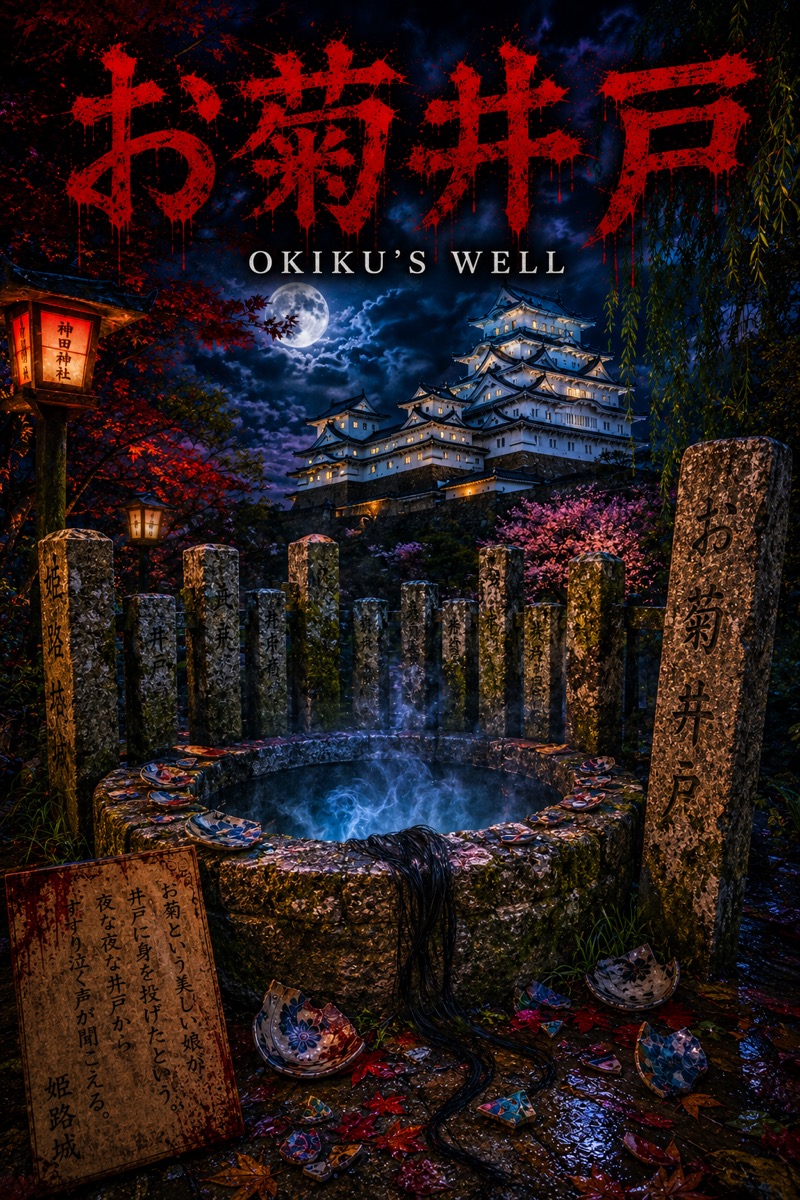
お菊井戸

Inside the grounds of Himeji Castle, one of Japan's most famous and photographed castles, there is a real stone well with a sign beside it naming it Okiku's Well. By day, tourists lean over the railing and look down into the dark. By night, the story says, the well begins to count. A woman's voice rises from below. One. Two. Three. Slow, even, patient. It climbs toward ten. Four. Five. Six. The voice does not hurry. It has been doing this for longer than anyone listening has been alive. Seven. Eight. Nine. Then nothing. In the place where ten should be, there is a silence that leans toward you. Then comes a sound that is not a word and not quite a scream. People who claim to have heard it say the silence after nine is the part they remember. Okiku, the story goes, was a servant accused of losing one of ten precious plates. She had lost nothing, but the truth did not matter against the word of a powerful man. She was killed and thrown into the well. Since then, she has counted the plates again and again, reaching nine and never finding the tenth, because the tenth was never lost.

The Truth Behind the Fear
The well is real and stands in Himeji Castle today. The tale is part of Banchō Sarayashiki, one of Japan's most enduring ghost stories, retold for centuries and adapted for kabuki, bunraku, and other forms. Like many ghost stories that survive this long, it is not really about the object at the center. The plates are not the point. The story is about a powerless servant destroyed by a powerful master, and the only justice the tale can grant her is repetition. She returns every night and counts what she was accused of losing, forcing the living to hear the missing number forever. The horror is not the scream. It is the unanswered nine.
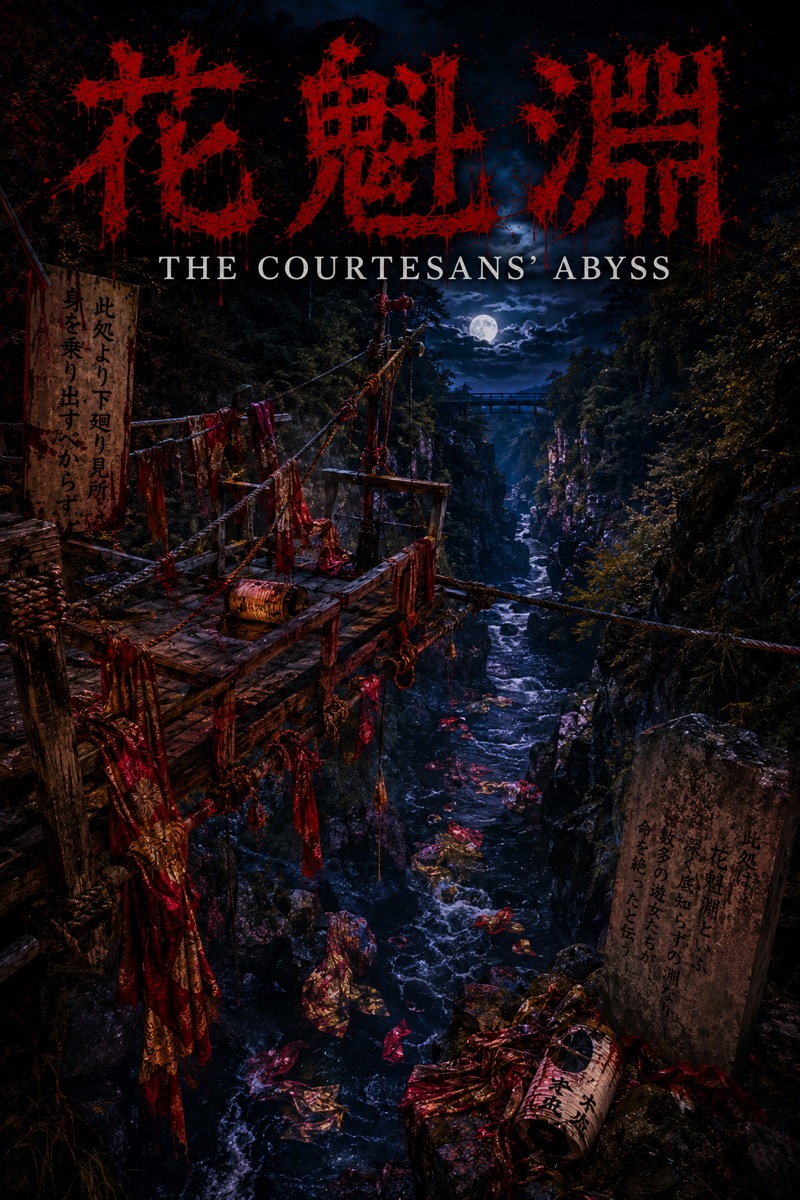
花魁淵

Oiran-buchi is a gorge in the mountains of Yamanashi Prefecture, off Route 411 near Yamanashi City. The name is usually translated as "the courtesans' abyss," and a monument at the site explains the old story in plain language. The legend goes back to the age of warring clans. The Takeda, it says, operated a secret gold mine in these mountains and could not allow its location to spread. When the mine was worked out, the men in charge were left with a problem: the women brought in to entertain the miners had spent years listening. They knew too much. So a wooden platform was built out over the gorge. The women were invited to a farewell celebration and told to dance above the water in their finest robes. Halfway through the dance, the supports were cut. The platform dropped into the gorge. Heavy robes pulled the women down. Those who survived the fall were taken by the current. People who hike there say that when the light goes, the river changes its sound. Under the water, there is something almost like music, faint and turning, as if the dance never ended.

The Truth Behind the Fear
The gorge and the name are real, but historians treat the details carefully. One reason is linguistic: the word "oiran" belongs to the Edo period, later than the Sengoku-era event the legend claims to describe. That suggests the name, at least, came after the supposed massacre. Accounts vary. Some say there were fifty-five women. Others say they were ordinary workers, informants, or people connected to the mine in different ways. What remains believable is the social logic underneath the legend: people with little power becoming dangerous only because they knew too much. Whether the number, names, and exact story are true or not, the gorge preserves a memory of disposable lives - people useful until they became inconvenient, then erased from the official record. The nearby road has also seen fatal accidents and closures from landslides, which has only deepened the place's reputation.
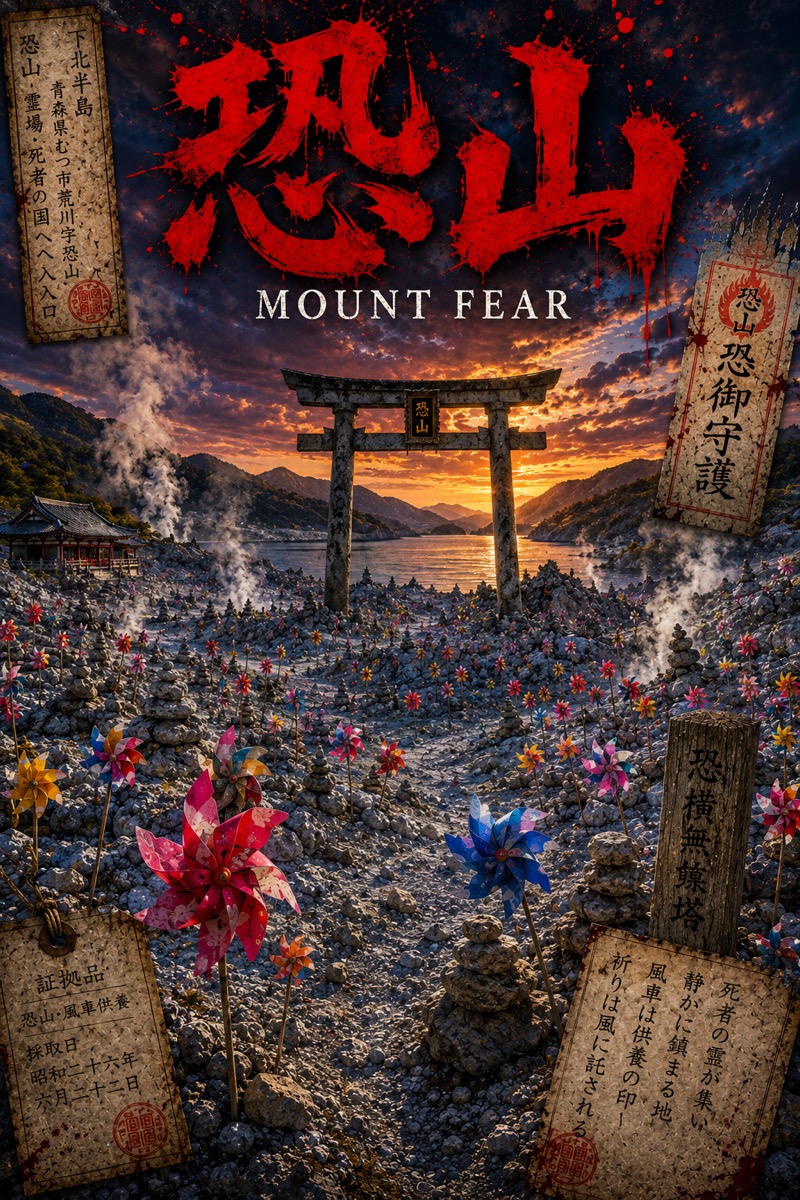
恐山

Osorezan means "Mount Fear." It sits on the remote Shimokita Peninsula in Aomori, at the far north of Honshu, an active volcanic caldera where the ground steams through cracks and the air smells of sulfur. The rocks are yellow, gray, and white. The lake in the crater is pale and beautiful in a way that feels almost wrong, its shore the color of bone. For more than a thousand years, people have treated this place not as scenery that resembles the land of the dead, but as one of its borders. To reach Bodaiji, the temple at its center, you cross a small red bridge over a stream associated with the Sanzu, the river souls must cross after death. Pilgrims will tell you the crossing is not only symbolic. The landscape does the rest. Broken volcanic fields become the plains of hell. Visitors stack small stones and leave bright pinwheels for children who died too young. On still days, the crater is quiet except for steam hissing from the vents and hundreds of pinwheels clicking in a wind you cannot feel on your own skin. People come here in grief, hoping to be close to the dead. Many leave feeling the dead were closer than they expected.

The Truth Behind the Fear
Osorezan is real, and it was never designed as a haunted-house attraction. That is why it lands harder than one. Bodaiji is a working Buddhist temple with a long history. The volcanic landscape truly resembles traditional images of the Buddhist underworld, especially the stone piles of Sai-no-Kawara, where dead children are said to suffer and be comforted. The itako, blind women trained as spirit mediums, have historically performed kuchiyose there, speaking for the dead so grieving families could hear what they needed to hear. Only a small number of itako still practice, especially around the summer festival. This is not a place built to scare tourists. It is a place people visit because grief has nowhere else to go. That is what makes it impossible to shrug off. End of Chapter II.

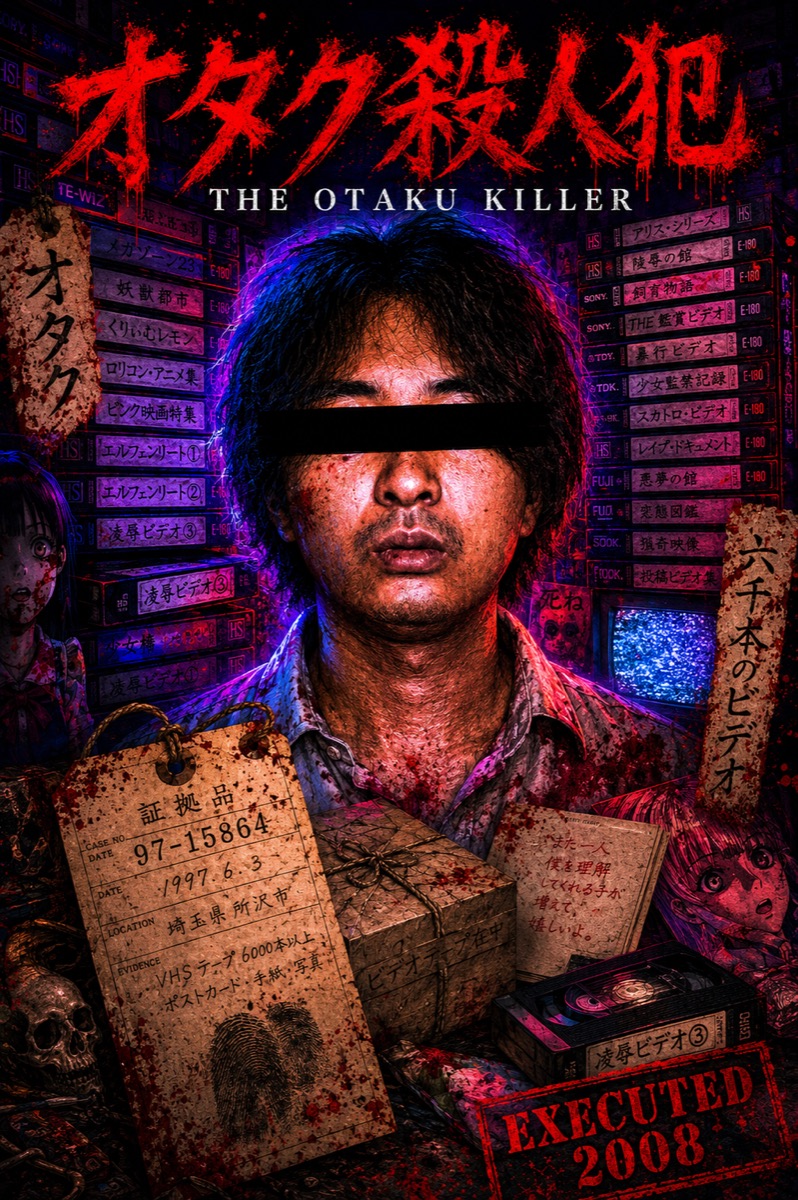
Start with the room. You have to start with the room, because everyone who tells this story does. Six thousand video tapes, floor to ceiling, wall to wall, stacked so tight you had to turn sideways to move. Horror films. Anime. Ordinary television, taped off the air and labeled in a neat, careful hand. A young man in his twenties lived in there, in the hills west of Tokyo. Soft-spoken. Awkward with adults. The kind of neighbor you would struggle to describe to a stranger because there was so little to him. Polite. Quiet. Good with the local kids, people said. Always happy to stop and talk to the little ones. Between the summer of 1988 and the summer of 1989, four small girls, the youngest only four years old, went missing from towns around Saitama and Tokyo. There was no pattern anyone could see. No link between the families. Nothing to connect a quiet street in one town to a quiet street in another. Just children, gone, and then, days or weeks later, found. In a cemetery. By a mountain road. In a way that felt, to the detectives, almost arranged. Almost displayed. Then one of the grieving families opened a parcel left at their door. Inside were a few of their dead daughter's belongings, a handful of her cremated bones, and a postcard. The card was a taunt, signed with a false name, inviting them to investigate, to prove what had been done. He had not just killed her. He had kept her, photographed her, catalogued her, and mailed the proof back to the people who loved her, for fun. He got careless in the end. They often do. A father came home and caught a stranger crouched by his car, photographing his five-year-old daughter. He grabbed the man, who went limp and apologetic, gave a name that matched no one, and was eventually let go. So you might think: a near miss, a lesson, a family that got lucky. The child that man had been photographing was dead within hours. He had simply gone back.

The Truth Behind the Fear
The man's name was Tsutomu Miyazaki. The press called him "The Otaku Killer," using a word, otaku, meaning an obsessive hobbyist, that would shape an entire decade of Japanese anxiety about young men who disappeared into their rooms and their collections. Many Japanese commentators trace the modern, suspicious meaning of the word "otaku" directly to this case, which conflated ordinary anime and manga fandom with the specific horror of what Miyazaki had done. He was arrested in July 1989 and confessed within days, describing the murders with an emotional flatness that defense psychiatrists later argued was evidence of severe mental illness. Three separate court-ordered evaluations reached three different conclusions about his sanity, and the trial dragged on for nearly a decade as a result. The Tokyo District Court found him criminally responsible and sentenced him to death in 1997. The sentence was upheld on appeal in 2001 and finalized by the Supreme Court in 2006. He was hanged at the Tokyo Detention House on June 17, 2008, alongside another condemned man, in one of the rare double executions in modern Japanese history. He never expressed remorse that satisfied the families he had destroyed. The case is still cited in Japanese criminology classes as the reference point for a specific, modern profile: the isolated, hobby-obsessed predator. It is a profile the public has never fully stopped fearing, and never fully stopped misapplying to people who deserve no suspicion at all.

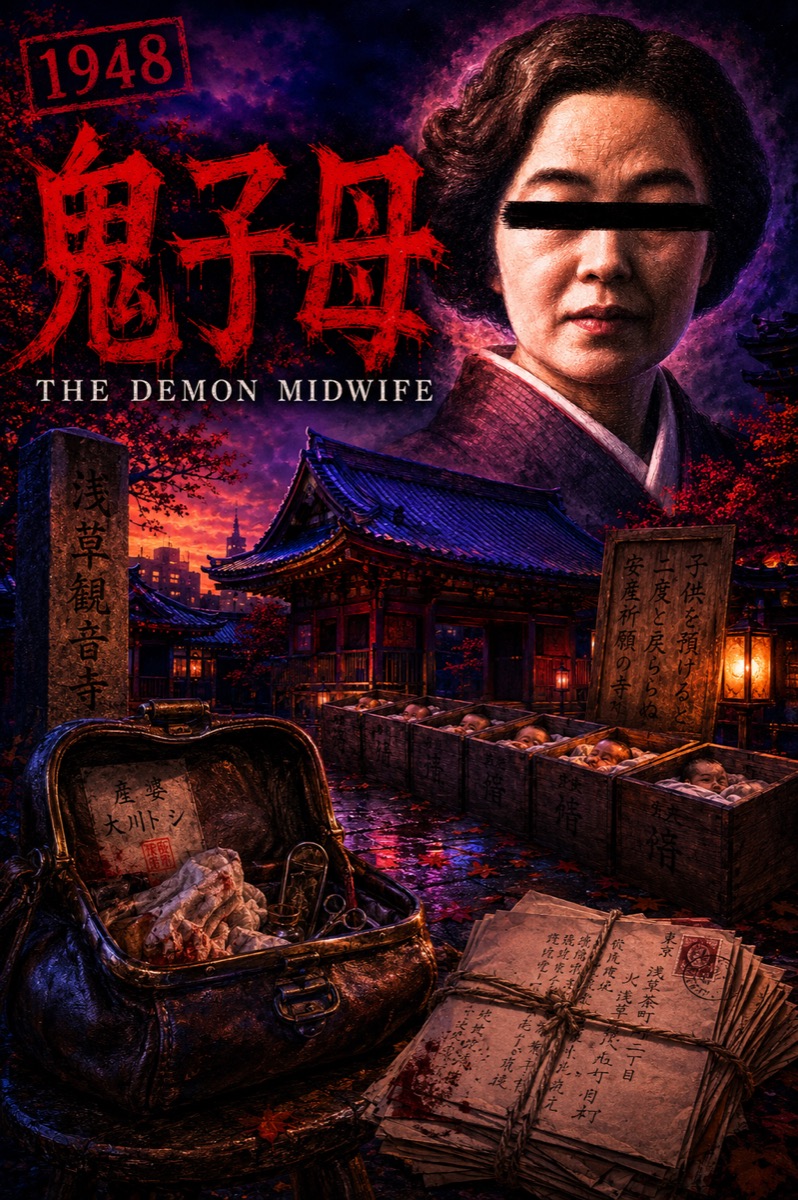
She was the woman everyone trusted. Sixty years old, soft-faced, a licensed midwife in a Tokyo still picking itself out of the rubble in 1948. The war had been over only three years. Food was short, money shorter, and the mothers who came to her were the ones with no one else: unmarried, ashamed, already with more children than they could feed. She offered them a quiet place to give birth and, for a fee, a kindness. She would see to it that the new baby found a family. That it would not become a burden. And the mothers believed her, because why would they not? They handed over their newborns and walked away lighter. Some of them, years later, wrote letters asking how their child had grown. The letters were never answered. There was no one left to answer for. It was the smell that ended it. Behind a temple stood a row of small wooden boxes, and the neighbors had been complaining about them long before anyone official came to look. When the boxes were finally opened, what was inside had been there a long time. Infants. Some only days old. Never registered, never reported, never placed with anyone, because the adoptive families had never existed. She had taken the money, taken the children, and let them die, one after another, for years, while the whole neighborhood called her auntie and brought her their own. When they tried to count them, they could not agree on a number. Dozens, certainly. Probably far more. And here is the part that should keep you up: in a city of millions, she had done this in plain sight, for years, and the only reason it stopped was that someone two doors down could not stand the smell anymore.

The Truth Behind the Fear
Her name was Miyuki Ishikawa, and the case, sometimes called the Kotobuki infanticide case after the Tokyo district where it unfolded, is one of the largest atrocities in postwar Japan that most people outside the country have never heard of. She worked with her husband and a local doctor. The doctor would issue stillbirth certificates for infants who had, in fact, been born alive. That allowed Ishikawa to take custody of unwanted newborns from impoverished mothers under the pretense of arranging adoption or care, in exchange for a "thinning-out fee." Investigators found roughly 103 to 169 infant remains connected to the case, though the exact figure is still disputed because records from that era are incomplete and partly destroyed. The number is made horrifyingly plausible by the social conditions of the time: a devastated economy, a black market in everything from rice to medicine, and a postwar legal system still being rebuilt from the ground up. Ishikawa was convicted in 1950, but received what many consider a startlingly light sentence, later reduced further on appeal. That was due in part to the chaotic state of child-welfare law at the time, and to ambiguity over how many deaths could be definitively proven as homicide rather than the era's already-high rate of infant mortality. She served only a few years in prison. The case directly prompted reforms to Japan's Child Welfare Act and the registration of newborns. For the families who never received an answer about a missing child, the reform came decades too late to matter.

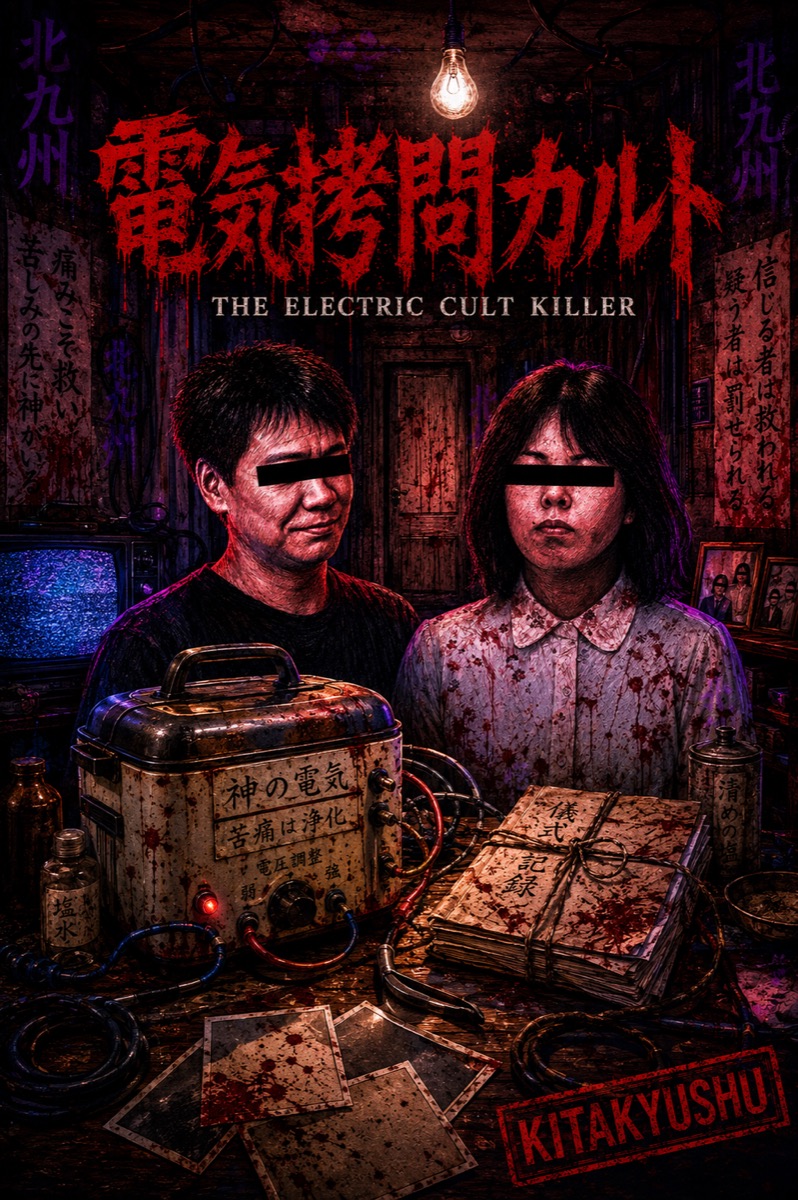
Some houses get a reputation for being cursed. This one earned it the hard way. Not with ghosts, but with what one family was made to do to itself, slowly, over years, behind a door the neighbors assumed was just private. From the outside it looked like an odd but harmless household in the industrial city of Kitakyushu in the late 1990s: a man, his partner, and a rotating cast of relatives and hangers-on, drawn in with promises of money, guidance, or just somewhere to belong. Inside, it was a machine for taking a person apart. First you were cut off from anyone outside. Then you were convinced you had wronged the household. Then you were made to atone, made to inform on the others, made to punish them when they failed, and made to be punished when you did. There was a device, modified to deliver electric shocks, and it was not used in anger. It was used on a schedule, the way you do a daily chore. Over the years the people in that house began to die. It was the surviving members of the family, broken down past the point of refusing, who dismembered them and scattered the pieces in rivers and the sea. They no longer understood that what they were doing was a crime. That alone would make this one of the worst cases in the book. But what investigators could not get past was not only the bodies. It was sitting across from the survivors afterward, from people who had been starved and shocked and turned into instruments, and listening to several of them defend the couple who had done it. They were free. They were safe. And they wanted to go back.

The Truth Behind the Fear
The case centers on Futoshi Matsunaga and his partner, often referred to in court documents by an alias, who together are believed to be responsible for at least seven deaths within an extended family network between the mid-1990s and early 2000s in and around Kitakyushu. The method - using existing family bonds and a manufactured sense of guilt to turn victims into instruments of each other's abuse - has been studied since as a textbook example of coercive control escalating to homicide, distinct from the more familiar "stranger cult" narrative. What makes the case especially chilling to Japanese criminologists is the absence of a conventional cult structure. No shared ideology, no charismatic doctrine, just one couple's systematic exploitation of family loyalty and isolation. Surviving family members, several of whom actively took part in violence against their own relatives under duress and psychological domination, were themselves prosecuted. That raised difficult legal questions about culpability under prolonged coercive control, a concept Japanese courts had little precedent for at the time. Matsunaga was sentenced to death in 2002. His partner received a long prison sentence after the courts found her degree of independent agency lower than his, though still criminally culpable. Japanese discussions of coercive control still come back to this case, precisely because it happened not among strangers drawn into a doctrine, but among people who were, on paper, family.

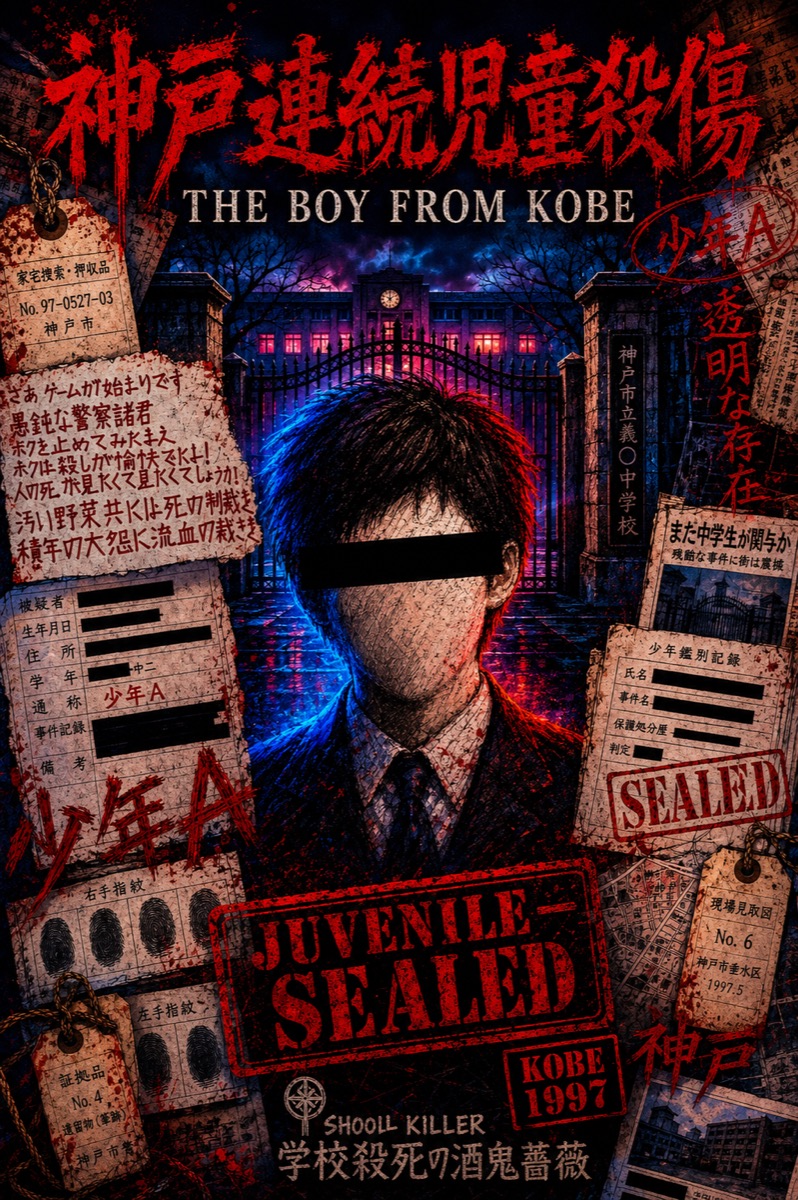
It started the way the worst ones do, with an empty space where a child should be. In the spring of 1997, in a quiet residential part of Kobe, an eleven-year-old boy did not come home. He was a small boy, a gentle one, a special-needs pupil at the local elementary school, and he had simply not arrived back from where he was supposed to be. For two days the neighborhood did what neighborhoods do. They searched, called his name, told each other he would turn up, knocked on doors, kept the porch light on. Two days of a family waiting by the phone and trying not to imagine. On the morning of the third day, the caretaker at a nearby junior high school came to open up before the students arrived and found something resting against the school gate. It was the boy's head. It had been left there deliberately, placed where it could not be missed, where children on their way to class would be the ones to see it. There was a note pushed into the mouth, written in red, addressed to the police. It called them stupid. It dared them to stop the writer. It said that killing was a thrill, that this was only the beginning of the game, and it was signed with an invented name built out of characters for demon and rose. More letters followed, sent to the local paper. Each one performed for an audience. Each one called the murders an experiment in how fragile a human being really is. A city that had buried its dead in an earthquake only two years before now lay awake at night over something worse, because an earthquake is at least nobody's choice. People stopped letting their children walk anywhere alone. Everyone was looking for the monster, and everyone pictured the same one: a grown man, big, obvious, the kind of evil you could spot coming. The police built their profile around exactly that. Handwriting was what undid him in the end. The script in those taunting letters was matched, the net closed, and on a summer day they made their arrest. And the profile - the grown man, the obvious monster the whole city had been bracing for - fell apart completely. He was fourteen. A junior high school student. A boy some of the dead child's own friends had passed in the hallway without a second glance.

The Truth Behind the Fear
Japanese law strictly prohibits identifying juvenile offenders, and that prohibition is one of the central, deliberate features of this case rather than an incidental detail. That is why this entry, unlike most others in this chapter, will not give a name. The killer, referred to in press coverage and subsequent writing only by the pseudonym he used in his letters, or simply as "Boy A," murdered an eleven-year-old boy and a ten-year-old girl, and seriously injured three other children, over a period of roughly two months in 1997. Because of his age, he could not be tried as an adult or sentenced to death. He was instead sent to a juvenile medical reformatory, diagnosed with a serious personality disorder, and released under a new identity after several years of treatment. That process, while legally required under Japan's juvenile justice framework, has remained deeply controversial with the Japanese public ever since, especially after he published a memoir under a pseudonym years later that several victims' families publicly condemned as exploitative. The case directly contributed to a 2000 revision of the Juvenile Act that lowered the age at which offenders could be tried in adult courts, from sixteen to fourteen. Decades later, it is still one of the cases people bring up first when arguing about how a society should balance the rehabilitation of a child against the permanence of what that child has done.

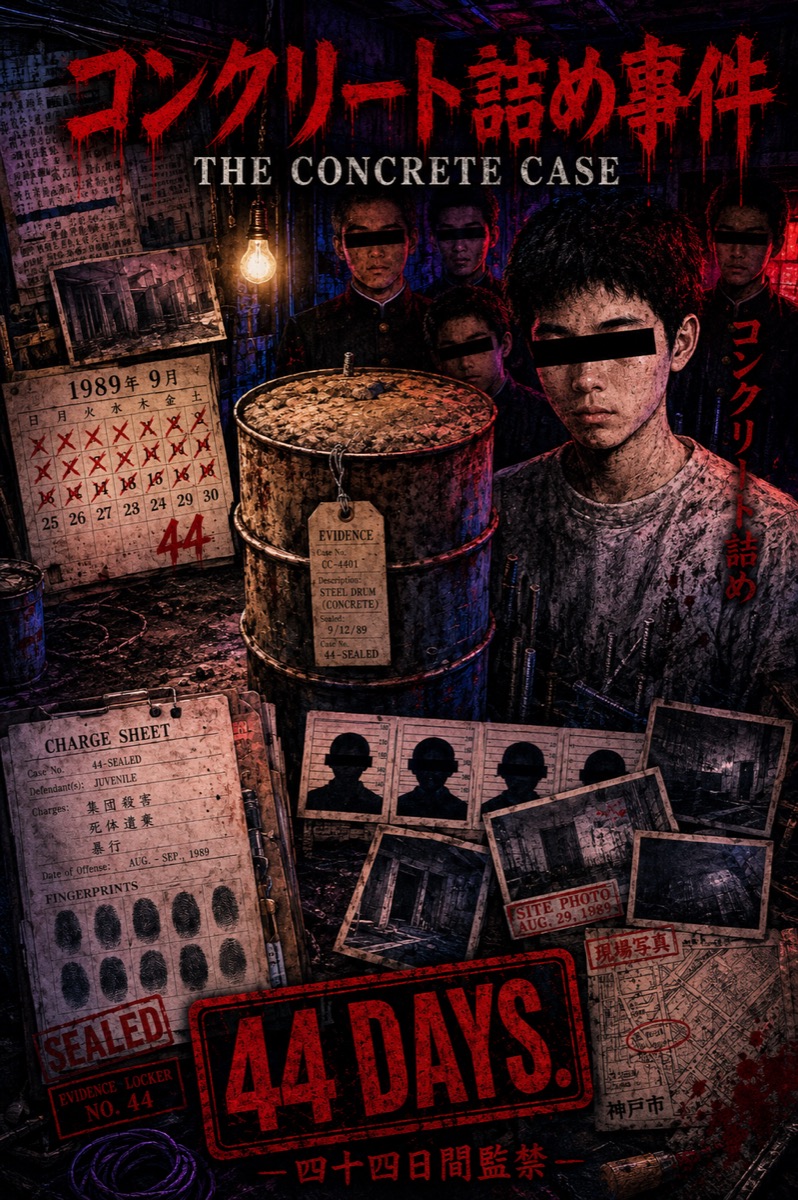
There is a kind of horror that does not need a monster or a mask. This is the worst of it, because the people who did this were teenagers, and every one of those forty-four days, they went home and slept in their own beds. She was seventeen, an ordinary girl in a Tokyo suburb: a part-time job, friends, a boyfriend, a normal life. In November 1988 a group of teenage boys grabbed her off the street. Some of them had ties to local organized crime, which mattered, because it meant the people around them were too frightened to ask questions. They took her to one of their family homes, an ordinary house on an ordinary street, and they kept her there. Not for a night. For forty-four days. She was held in an upstairs room of that house while the boys came and went. What they did to her over those six weeks is recorded in court documents in detail this book will not put in front of you. Two things are enough to understand it. The first is that it was not a single eruption of violence; it was steady, daily, and casual, fitted around school and meals and ordinary teenage life. The second is that it was not a secret. Other young people visited that house while she was in it. Friends of the boys passed through, knew, or guessed, and went home. The boys' own family was in the house. For forty-four days, a city full of telephones sat within reach, and the call that would have saved her was never made. She did not survive. When it was over, the boys sealed her body inside a steel drum, filled the drum with wet concrete, and left it at a building site, where it sat until it was eventually found. Many cases in this book are this cruel. What makes this one unbearable is not a single moment of it. It is the arithmetic. Forty-four days. Forty-four chances for any one of the people who knew to do the smallest, easiest thing in the world. Forty-four days in which not one of them did.

The Truth Behind the Fear
This entry withholds her name, even though it has circulated widely in other accounts of the case, because this book's policy is to let the perpetrators carry their crimes in print and to let victims rest without becoming a search term. The young men who tortured and killed her, all minors at the time of the crime, cannot legally be named in Japan, and this entry follows that law, as the chapter's introduction promised. The four primary perpetrators were convicted in 1990 to 1991. Because of their status as juveniles, and significant ambiguity in the original charges and sentencing, the case became a landmark moment in Japanese public criticism of the juvenile justice system. The public widely viewed the sentences, ranging from roughly five to twenty years, as catastrophically lenient given the severity of the crime. National outrage intensified after some of those convicted were released and went on to commit further crimes, a fact that has never stopped circulating in Japanese true-crime discussion to this day. The case is frequently cited, alongside the Kobe child murders, as one of the two cases most responsible for shifting Japanese public opinion toward harsher treatment of juvenile offenders. For her family, the legal aftermath has remained, by their own public statements over the years, a wound that the passage of time has not closed.

This one is close. Not a remote village. Not the rubble of the postwar years. Nothing you can hold at arm's length as belonging to another time. This happened on the app in your hand, to people whose only mistake was to say, out loud, in public, that they did not want to be alive anymore. Over three months in the autumn of 2017, a man in a small flat in Zama, just outside Tokyo, searched Twitter for exactly those people. When he found one, he reached out gently. He understood, he said. He could help. Sometimes he offered a method. Sometimes only a place to come, a sympathetic ear, the relief of being understood by someone at last. They messaged him in the worst hours of their lives. And then, one after another, at least nine of them made their way to his door. Not one of them came back out. When the police finally opened that flat in late autumn, they were not even looking for most of the people they found. The smell had reached the neighbors weeks earlier. Nobody had called.

The Truth Behind the Fear
The killer's name was Takahiro Shiraishi. During his trial, he admitted to all nine killings, and his defense initially tried to argue that several of the victims had consented to their own deaths. The court firmly rejected that claim, finding instead that Shiraishi had deliberately sought out vulnerable people expressing suicidal ideation because their distress made them easier to lure, kill, and dismember without raising early suspicion. Several of the victims showed clear evidence of resistance. He was convicted and sentenced to death in December 2020, a sentence the Tokyo High Court upheld on appeal. He was executed by hanging in June 2025, one of the relatively rare cases in modern Japan where the period between conviction and execution moved with unusual speed, a fact that itself drew commentary given how often capital cases in Japan stretch for a decade or more. The case led Twitter, now X, to revise its policies around self-harm and suicide-related content. It remains one of the most frequently cited examples, alongside cases in other countries, of predators using the language of crisis support to locate and exploit people in genuine psychological danger. For a country that already struggles publicly with how to talk about suicide, the case added a new, technological layer of dread to an old and serious problem.

Some of the entries in this book are about people who hid for years. This one is about thirty-six minutes, and the building full of people who had done nothing that morning except come to work. On the 18th of July 2019, a man walked into the ground floor of a beloved animation studio in Kyoto, a place known around the world for gentle, hopeful, beautiful work. He poured petrol across the floor and set it alight. He did it at the foot of the stairwell, which was the one way down from the upper floors, so that the only road out became the fire itself. There was no second outside staircase. The people on the upper floors went up instead of down, toward the roof, toward air, and the smoke went with them. Thirty-six people died, most of them artists in their twenties and thirties. Firefighters found some of them at the top of the stairs to the roof, together, where they had climbed as far as a locked-in building would let them and then run out of building. The man who did it survived, badly burned, screaming to the people who pulled him clear that the studio had stolen his story. It had not. There was nothing. But the families do not get to file that under nothing, and neither do we, because thirty-six of the most gifted people in their field went to work on an ordinary Thursday and a stranger's delusion decided they would not go home.

The Truth Behind the Fear
The man's name was Shinji Aoba. Investigators determined he had no actual connection to the studio and that his belief about stolen work was a delusion, not a genuine grievance. The court still found him criminally responsible, ruling that his mental illness, while real, did not rise to the legal threshold that would excuse him from culpability under Japanese law. His trial in 2023 to 2024 drew significant international attention, both because of the scale of the loss and because the proceedings forced a public reckoning with how Japan's legal system weighs serious mental illness against criminal responsibility in mass-casualty cases. He was sentenced to death in January 2024. The sentence became final in 2025 after the period for appeal lapsed without a further challenge being filed. The fire prompted an outpouring of donations from fans of the studio's work around the world, and led directly to revisions of Japanese fire-safety codes regarding secondary egress in multi-story buildings. It was a small, hard-won mitigation against a tragedy that otherwise offered no comfort to the families and coworkers left behind. The studio rebuilt and continued operating, a fact often noted, with quiet, complicated pride, by those who survived.

Picture a village so small and so old that nobody locks a door, because there has never once been a reason to. A scatter of farmhouses in the mountains of Okayama, everyone related to everyone if you go back far enough, the kind of place where a stranger would be noticed before he reached the second house. In 1938, Kamo was a hundred and eleven people in twenty-three households. The danger, when it came, was not a stranger. That was the whole problem. The danger had grown up here. His name was Mutsuo Toi. He was twenty-one, and the village had spent years quietly turning its back on him. He had tuberculosis, and in that time and that place it made him someone to keep at a distance. So they did. He felt every inch of it, wrote it all down, and kept the account. Then he began, calmly, to prepare. A shotgun, bought legally on a hunting license. A katana. Daggers. An axe. Two hundred rounds. And then he waited for a night with no moon. On the evening of the twentieth he climbed a pole at the edge of the hamlet and cut the electricity, and Kamo went black. At half past one in the morning he killed the grandmother who had raised him, with the axe, while she slept. He wrote afterward that he did it so she would not have to live as a murderer's grandmother. Then he got ready. He strapped a torch to each side of his head, so his hands were free and so the last thing his neighbors would ever see was two blinding lights swimming toward them out of the dark. He shouldered the gun, took up the sword, and stepped out his own front door into the sleeping village. For the next ninety minutes he went house to house through the place he had lived his whole life. He knew every door, which way each one opened, and exactly who was sleeping behind it. By the time the sun came up it was over. He climbed the mountain above the village, sat down, and turned the shotgun on himself. You might call that the end of it. One broken young man, one terrible night, a murder-suicide that died with him on that hilltop. Except the village had a name, and after that night the name began, slowly, to be spoken less and less, until the maps moved on and the hamlet was folded into somewhere larger and the place where it had stood went quiet. People still tell stories, in the north, about a village that one of its own wiped out in a single night, a village you supposedly cannot find anymore. They tell it as a ghost story. They do not always know they are telling this one.

The Truth Behind the Fear
The Tsuyama Massacre, the Tsuyama jiken, is a matter of exhaustive public record, and it remains the deadliest mass killing by a single person in modern Japanese history: thirty victims, plus the perpetrator, in one night, in a hamlet now absorbed into the city of Tsuyama. Mutsuo Toi was twenty-one. He cut the village's power on the night of 20 May 1938, killed his grandmother around 1:30 a.m. on the 21st, and then killed his neighbors with a Browning shotgun, a katana, and an axe over roughly ninety minutes before killing himself. Twenty-seven died where they lay, two more from their wounds, and three were seriously injured but survived. He left suicide notes, and they survive, which is why we know his reasoning at all: page after page of resentment, focused largely on how the village had treated him after his tuberculosis diagnosis the year before. This is also, almost certainly, the true source of a legend elsewhere in this book. The story of a remote northern village wiped out in a single night by one of its own, the place then quietly scrubbed off the map, is the seed of the Sugisawa Village myth. You can see exactly how a real horror in a real mountain hamlet hardens, over decades of retelling, into a cursed place that supposedly cannot be found. The difference is that Kamo can be found, and the names of its dead were written down, and the reason it happened was not a curse. It was a sick and bitterly isolated young man, a community that froze him out, and a box of shotgun shells. The massacre left a deep enough mark on the Japanese imagination that it has been fictionalised many times over, most famously as the inspiration behind a classic Seishi Yokomizo mystery. The fascination is understandable. The thing worth remembering is harder, and quieter: every door he walked through that night was a door he had walked through before, in daylight, as a neighbor. End of Chapter III.
Afterword
A Final Word

You reached the end.

Not many people do, with a book like this. Most read a few stories in daylight, decide that is plenty, and set it down somewhere they will not have to look at it again. You kept going. Into the tunnels and the forests, the rooms nobody wanted to talk about, all the way to the last name in the last chapter.

So you already know how it ends.

The tunnel was a real accident. The village was a real massacre. The woman in white was once a real woman, failed by everyone around her long before she was anything to be afraid of. Again and again, the monster turned out to be the gentler story, the one people could actually stand to tell.

Underneath it, every time, was something worse. A death. A cruelty. A name someone spent their whole life trying not to say.

That is all a haunting really is. Not a spirit. A debt. Something that happened and was never answered for, still sitting in the place it happened, waiting for someone to notice.

So this is the last thing we will ask of you.

When you hear that somewhere is cursed, do not reach for the ghost. Reach for the history. Ask what happened there. Ask who it happened to. Ask why the people left behind needed a monster to make it bearable.

That is usually where the real one has been standing all along.

We are glad you walked this far with us. Truly. Not many do.

Now close the book.

Some doors are easier to open than to shut, and you have held this one open long enough.

Sleep well.

Or don't.

The Anti Yūrei Yōkai Club
Who We Are
The Anti Yūrei
Yōkai Club

We are a small group with an unhealthy interest in the dead, and in the places they will not leave.

Most nights you will find us out in one Japanese city or another, leading a few people down a street the tour buses never reach. We stop at a dark shrine, a bridge, a doorway that feels wrong, and we tell the kind of story that makes everyone go quiet at the same moment. Then we tell them what really happened there. That part is usually worse.

This book came out of those walks, all over the country. It is our attempt to take a Japanese night, the wet stone, the paper lanterns, the footsteps that might be yours, and press all of it flat onto paper.

But paper can only hold so much.

You read these stories somewhere safe. In the light. With a way to close the book whenever it got too close. That is not how they are meant to reach you.

They are meant for a narrow street with no one else on it. For the pause after the guide stops talking, when everyone realizes they are listening for something that should not be there. The best of them do not end on the page. They end in the dark, in the exact spot where the real thing happened, with you standing on it.

So if something in this book followed you home, come and find us. We walk after sunset, in the cities where these stories happened, and we will show you where they still live.

A few of them only finish once you are there.

Find our tours, and more of what we have collected, at

antiyureiyokaiclub.com